Showing posts with label Energy. Show all posts

Monday, 12 November 2007

Injunction scans

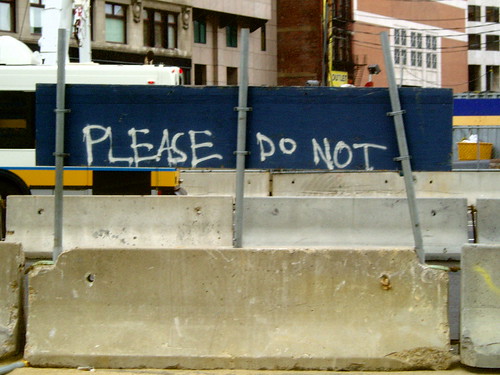
photo: civic injunction by jbartok


I believe it was Timothy Gallwey, the father of executive coaching who originally said

'performance equals potential minus interference.'


He first used this idea in a sporting context, especially with reference to athlete's doubts, distractions and negative internal dialogue.

But for the purpose of this article I want to apply this principle not so much to individual performances, but to the larger scope of what people decide to perform in.

People usually perform the best when they have a maximum of enthusiasm. They also seem more dynamic, attractive and convincing to others when they are enthusiastic. Naturally I can think of exceptions to this. Enthusiasm is not a substitute for skill. But it often precedes and leads to skill.

Children often show great capacity for enthusiasm. At least when they are left to play. Adults often show less enthusiasm. Somehow in the civilizing process education can damp down enthusiasm.

Let me give a personal example from that messy ground between being a child and an adult.

As a teenager my dream was to go to Taiwan and study Chinese martial arts as my Taiji teacher had done. My parents did not really understand why this was so important to me. They encouraged me to go to University and get a degree. Eventually I gave in, partly pushed by my parents, and partly lured by tales of student parties - something I could also feel enthusiasm for.

So I spent three years studying Environmental Biology, but my heart was not completely in the work. Biology fascinates me, whispering to me about the miracle of our interconnected lives. Despite this I did not appreciate what an amazing privilege it is to be able to choose to study a subject like that. At the time University seemed like an extension of school, but with beer, girls and scuba diving.

So after I graduated it was not long before I left England and found myself on wandering the streets of Taipei, knocking on doors and looking for teachers.

That's how I first met Luo De Xiu in 1991. He impressed me not just with his fluid power and skill, but also by his infectious enthusiasm for the arts he practiced. Sixteen years later he still lights up like a child when talking martial arts. A living example of how skill and enthusiasm go hand in hand.

Excuse me, I am digressing a little. My point is that I had been temporarily deflected from what I felt truly enthusiastic about. Once I got back into the groove of what was important to me, my life was felt magical and my energy soared, not just when I was in Taiwan, but when I was on my way too. I hope that you have had some experiences, made some choices that had this effect on you too.

Now my question is what interferes with us living more of our lives this way? What stops us going from what we really want?

I describe one kind of dampener as injunctions. These are rules, that come from different sources that say how we should and should not live. They can be subtle, or brutal. We often internalize them, so that we forget how they limit or potential options. They guide our lives, invisible and unquestioned. People live without enthusiasm for what they do, because they are unable to even see anymore what they are truly enthusiastic for.

So in the story above my parents injunction was something like 'good boys get degrees.' That one is fairly benign, and there is a pretty clear positive intention and assumption behind it - a good education leads to a good living.

But there are plenty of other injunctions. Often they apply to getting what we want.

My sister in law told me that in the school she went to she was discouraged to ask for things directly. If you wanted someone the salt you were expected to ask someone 'Would you like some salt?' to which they were expected to reply 'No, would you like some salt?'

Some typical injunctions include
  • It is selfish/rude/arrogant/greedy to ask for what you want
  • If you ask for something you will not get it
  • Saying what you want gives other people power over you
  • Good boys/girls do not do that
  • It is your duty to sacrifice
  • What makes you think you deserve...
  • People will be jealous if I get what I want
  • I will probably just be disappointed
I could go on, and on, and on...

Of course all of these injunction have some kind of positive intention. They are taught as a way of maintaining the structure of societies and families.

I believe that once we have the ability to to think reasonably, rationally and ethically then they are up for questioning. Society is changing with technology. People have higher levels of education than ever before, and given more choices I believe that people will tend to act more generously towards one another. A lot of the old injunctions simply do not apply anymore, and they certainly deserve the scrutiny of intelligent mature people.

So if you want to liberate some extra energy, widen your options, and charge up your enthusiasm then give yourself an injunction scan. Perhaps some of the ones above seem familiar to you. You can probably find others.

To find them ask yourself what you should or should not do. Think of the people around you in your culture, what are the rules they live by implicitly? Have you taken them on too? Contrast these with the rues of other cultures you may know, and what do you learn? Do the injunctions stand up in the light of awareness? What are their positive intentions, and can you find other ways of fulfilling them?

The more you clear your internal landscape of weeds like this, the easier it will be to see clearly what is important to you, to what you really want, hear it calling and feel the pull of it into the pleasure of bringing more and more of your gifts to the world.

And what do you really want?


Monday, 15 January 2007

An exercise to increase Physical Intelligence

I recently started doing this in a quiet moment. It is very simple exercise I've put together and decided to call Kinesthetic streaming. It is similar to a number of other techniques. In doing it the first time I gained some interesting insights into how I think about and use my body.

But first what do I mean by physical intelligence? Well I’m talking about awareness of the structures in the body, bones, muscles, tendons, and visceral organs. Parallel to this is an awareness of emotions, energy and metaphors within the body. Finally there is a linking between awareness of these structures and the ability to move and therefore act, in the world.

I’ll describe the exercise, then write a little about some experiences I associate with it and then about some techniques that are similar.

So now the exercise

1. Close your eyes
2. Describe to your self your physical sensations, in as much detail and as rapidly as you can. Carry on for from 5-10 minutes.
3. Notice if there are parts of your body that you simply did not notice? Notice any other patterns.
4. Deliberately begin to include those parts of you that are normally outside of your awareness.

5. Re-orient to the outside world.

In doing this you may find you are aware of more than pure feeling. Images, memories, metaphors, synesthesias may well all be woven in. The important thing is that you find yourself discovering more about how you represent your body to yourself, you update your map of your body, you gain faster deeper access to sensation.

The use of words in this exercise act like a bridge between different parts of your mind. They are a focus that helps keep you in the exercise rather than drifting into a daydream. Another consequence is an increase your ability to use words to describe the realm of interior physical space.

For variety you can do this exercise in different postures (sitting, standing, cross legged and whatever else you might want to try). Observe how the postures affect your attention and sensation.

You can also experiment with longer, or shorter periods of practise. The shorter ones could just be a way of checking in with your state in the midst of daily activity.


Some experiences sources and parallels

When I think of this exercise I remember a conversation I once had with the fool. He explained how he would meet various Yogis and martial artists, and they would talk about qi, or prana or use other names for subtle energy. He often didn’t find these people either grounded or practical, and challenged them.

‘So you can feel your subtle energy. Mmmmm, now tell me, what is the sensation on the inside edge of the third toe on your left foot. If you can’t tell me that, if you not aware of your physical body how can you talk about your subtle body?’

I agree. In martial arts we can talk about qi, but in the beginning it's more helpful to think about, time and measure, angles, momentum and vectors. Once these are clear it's time to get into 'energy'. If you focus on qi without getting past some basic physical training then anyone with a half decent straight left will be quite capable of dishing out a revolutionary experience for you!

Another person I associate with this exercise is a man who I met on an NLP training. The trainers (not me in this case) referred often to paying attention to somatic information - feelings. This man had been trained from an early age in the Cartesian tradition in which somatic information was of no use, an animal illusion.

It is not that he did not have feelings. He just had lost his ability to notice them, or value them. However his thinking mind was still able to notice that the apparently intelligent people around him did have feelings, did value them, and could use them in ways which intrigued, but escaped him.

During a break he confided to me

‘These feelings they are talking about, I don't know what they mean. I think that feelings are accessible to women, but not to men.’

I nearly choked on my tea. I’ve spent years immersed in physical awareness, swimming in kinesthetic as one person described the experience. It has taken me a some time to balance that strong kinesthetic with other ways of thinking and acting in the world. I am a man and I am aware of feelings – who was he to imply that was impossible, dammnit!

I didn't choke on my tea because I recognised that under his blanket statement was a yearning. He recognised somehow that much of his energy was caught up in keeping out the perceived chaos of the body. That meant keeping out much of life at the same time. He chose me to talk to because he recognised me as an exception to his rule, and thus a way into a different set of possibilities. I can't remember what I said, and I did not have this exercise to offer then. It will be a regular part of my training from now on.

Kinesthetic streaming is quite similar to self hypnosis exercises where you make statements describing sensory reality, interspersed with suggestions to go into a trance state. One difference is that typically in trance exercises is the rhythm, which is linked with the breath and tends to slow down. In this exercise the idea is to maintain a rapid pace, and no suggestions are involved.

It is also a very similar to Win Wenger’s image streaming exercise – in which internal imagery is described as rapidly as possible. Win claims that daily practise of image streaming permanently raise the IQ.

It's too early to say for sure, but I think that regular practise of this exercise may permanently change the way you relate to your body. Since our bodies are the medium through which we experience the world, and through which we act on the world that could mean a lot.

This is a new exercise. I'm interested in how people can use this and develop it. If you decide to try this out I'll be very happy to read about your experiences.

So if you close your eyes now, what do you feel?


Monday, 11 December 2006

Paris Sans Clopes – the energy of habit


Now if you are reading this outside of France the title of this post may not make much sense to you. Pretty much everyone knows what Paris is, but 'les clopes?' Clopes is colloquial French for cigarettes, and smoking (verb: cloper – to smoke). In February France follows America, Ireland, Holland, Norway, Montenegro and many other countries in introducing legislation to prohibit smoking in many public places.

Now the change in France is not going to happen overnight. Café’s and bars have a year’s grace period to adjust. But why am I writing about this in an NLP Blog? Well smoking is such a universal, experience and such a good example of a unwanted habit that we often use it as an example to illustrate certain NLP principles. So now that a whole country is aiming to get healthier I’ll take advantage of it here.

We use smoking as an example because there are a lot of people who want to stop smoking, but find it hard. One reason they find it hard is because they start off with a badly formed outcome in mind. They want to not do something. Well formed outcomes are stated something positive to be, do or have.

Wannabe non-Smokers are also at war with themselves. They usually have a string of reasons for smoking as long as their arms. But they are rarely aware of more than just a few of their reasons to smoke.

These are what we call the positive intentions of smoking, and typically include having a treat, having a break, punctuating the day, a way to start a conversation and part of a sense of identity. People often say that they are smokers, they define the world between smokers and non smokers.

If they do not address these positive intentions then in stopping smoking they find themselves missing out on a whole host of what makes life good for them. They don’t know how to have those intentions can be fulfilled in all sorts of different ways.

Not only do they have all these hidden reasons to smoke, they also have a lot of beliefs about smoking. Nicotine is very addictive, giving up is hard, and each time they light up after a period of laying off they consider themselves to have failed.

So now France is in the same position as many of those people. Smoking is (decreasingly) a part of the French national identity. Many Café’s have a tabac, a counter where there is whole range of tobacco products on sale – as well as stamps and lottery tickets. For many people sitting at the zinc counter of a café, ordering a coffee and lighting up a cigarette (perhaps a Gauloise) is a quintessentially French activity.

That is all under threat. That part of French culture is going to die, and people on the tobacco side of it are nervous.

Personally I’m curious. Not just curious, I’m looking forward to it. It’ll be great to be able to drop off my daughter at school, and have a cup of tea in café which has clean air. I’ve seen it happen before in other countries, in houses and households, and I've liked he results.

But when you are on the other side of that change, it can see strange and daunting. Like going from childhood to adolescence, or adolescence to adulthood.

Paris has already started though. I see a smaller proportion of people who smoke, and a general cleaning up of the city. For example there is much less dog mess on the street than when I moved here 6 years ago. Not that I want to draw any parallel between dog shit and cigarettes for the smokers among you. I mean what would you want to clean first, your fingers or your lips? Please don't think about that whenever you see a cigarette, it might spoil your pleasure.

The reality is that this kind of change can be easy. There are moments that people recognise that something does not fit their sense of identity, that they have moved on and the old ways are no longer necessary.

People readjust their actions when they examine their values. I know that when I stopped smoking one reason was I didn’t want to pay my money to companies with a long history of deliberately lying to sell damaging drugs to large sections of the population. What’s the word for those people? Scumbags I think.

No, that’s not very compassionate of me. People knowingly trying to hook other people on carcinogenic chemicals aren’t really murdering scumbags. They are just misguided and doing their best to make a living. Just like arms dealers, and the rest of us embedded in a society that invests money in destructive unsustainable activities. At what point do people own up to what they are doing as wrong?

But rather than getting all angry – which sometimes is justified and a useful motivator, we can also turn towards something more positive.

Something else that helped me leave cigarettes in my past was having something else that I really wanted to do. Once I discovered freediving I lost all desire to smoke. Images of myself playing in the ocean wiped out any temptation. We all have dreams that can motivate us.

Someone at a French NLP training I attended recently gestured to a non-smoking sign. It was the usual crossed out cigarette. He stated that there was no other way of giving the message of no smoking.

I disagree. Representing a positive goal that is not compatible with the unwanted activity would work. So a picture of blue skies, or mountains, or a windswept ocean with the words ‘keep the air clean’ or ‘enjoy a breath of fresh air’.

So you may not smoke, and you may not live in Paris – if you do both of these then you might think of visiting Mike Fink (Mike's site is in French and he also works in English). But you may have some activity or habit that gets in the way of what you really want to do.

When you talk with someone who admits that they want to give up their habit, it can be helpful to motivate them to change by kicking their ass, by pointing out the negative consequences of continuing as they are.

I also find that it’s helpful to recognise that even scumbags have reasons to do what they do. If I am going to help them find a new way forward I’d better have a sense of how to incorporate those reasons into any new plan, or way of being. It’s bit like blending with and using people’s force in martial arts. It makes life easier, less violent and takes the existing energy and channels it in a new direction.

So where might you have some energy that could use re-channelling? It may not be a conventional bad habit like smoking. It could be something as subtle as thinking negatively. Then the next question is, once you have freed that energy where would you like to see yourself put it?