Showing posts with label Stories. Show all posts

Monday, 19 November 2007

Rehearsing pain, rehearsing pleasure

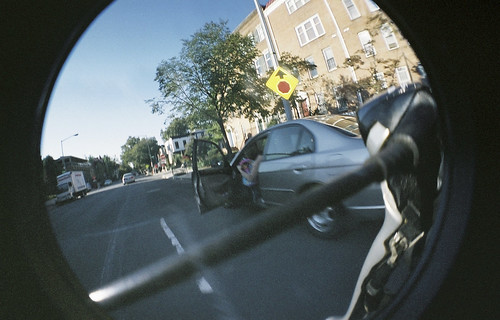
photo: Bike to work by e.wilder


Last week a car door gave me a lesson in NLP. The cyclists among my readers will already be sighing...

It was Tuesday morning, I was pumping up a steep hill working desperately to get my daughter Jyoti to school on time. Then with a timing I could not avoid a man in a smart car opened his door. Pieces of bike cracked off as we skidded and fell to the left.

My body and the wrong part of my training took over. I had hardly hit the ground and I was up again. There were no cars or buses about to crush us and my daughter seemed unhurt. In front of me was a an open car door inside of which was the target of 15 years of bottled cycle rage. My right fist felt like it could smash metal, and there was an open line between it and the scared face of the driver. My lungs were supplying plenty of volume to a mix of obscenity, incrimination and threat. The driver shrank in his seat.

I do not know how long I stood there, perhaps two or three seconds, but it felt a long time.

A better part of my training took over. I saw fear and regret on the driver's face. I was aware of passer's by coming to help, my daughter was crying. I turned to lift her off her bike seat and comfort her.

Jyoti was ok, my bike was mostly ok. The passer's by brought the pieces of bike that had flown off on impact. The driver, upset, went to hug my daughter as I held her. I let him.

Jyoti told me she was fine to get back on the bike. We even managed to get to school on time. As we pedaled off I saw that the driver was having trouble shutting his car door.

Later as I thought about what happened I felt a little ashamed. Yes I looked behind and saw my daughter was Ok, but I tended to my rage before I tended to her well being.

I understand how I did that. I have been an urban cyclist almost daily for since the early 1990's. Many times I have nearly been killed and injured by the thoughtlessness of people piloting 1000 kg steel clad fists through the streets. Most of the time it was just thoughtlessness, lapses of awareness, moments of carelessness. Occasionally it has been malicious, people deliberately cutting close, swerving and aiming for me.

Insulated in their steel fist most drivers do not think of what is like to be on a flimsy wheeled frame powered by lungs and thighs, seeking the safest route between unfeeling obstacles.

When some coddled driver, in their impatience and thoughtlessness nearly kills you, it is hard not to take it personally. As a result I built up layers of self justification.

I had created a scenario where at last I would be able to express my righteous anger....

...Not nearly hit this time, but hit. The driver would be out of their armored casing, they would have already struck the first blow, and at last I would be able to strike some back. Self defense, clearly, little me armed only with my hands (elbows, knees, head and possibly a D-lock), against 1000kg fist man. Every blow would come straight from my belly, a whole body communication saying: PAY ATTENTION TO CYCLISTS

Variations include disarming my attacker by throwing their car keys down the nearest drain.

That is what I had been rehearsing mentally. It is nearly what I did. the pained shock on the driver's face is what stopped me. If he had been aggressive he probably would have been toast.

The positive intention in my hitting back scenario clear. But is hitting people the best way to get the message across - pay attention, drive safely, respect the fragile, fleshy two wheelers?

Every time I got a little satisfaction from imagining demolishing a dangerous car I was making it a little more likely to happen. Rehearsing this way I was loosing flexibility in getting my real message across, and putting myself in a legally dangerous position. I was also filling my body with stress hormones and missing out on what is actually happening and important (like bad driving), and what I might take pleasure in, people, weather, light.

So I am going to change my mental rehearsal with cycling. Change it from some fixed scenario, to remembering what I consider important. I will rehearse the qualities that allow me to say 'we are all human, let's look out for each other, and maybe even have some fun.' I will rehearse awareness in the place of rage. This is something my life depends on, literally. Fortunately, I am well trained to do this.

It is more than just cycling. I am also looking out for all the other unhelpful scenarios I am rehearsing. Lots of relationship arguments are based on this kind of imagined scenarios 'if she says this I am going to lose it...'

How many other stupid situations will I be able to avoid and turn into possibilities for pleasure? That is all very well for me, what about you?


Sunday, 7 October 2007

Right and Easy

photo: Right is easy by LN


A conversation I had at a training recently stayed with me. Perhaps because I felt quite happy to quote an unusual and famous person. Perhaps because there was something unclear about my answer.

But before I offer the quote, let me set the scene.
In the course we asked the attendees to remember a time just before they made decision that they later regretted.

Additionally in the moment they made the decision, they had some sense of warning, some signal that told them they would regret their choice. Which they did.

We do this to help sensitize our clients to their own inner warning signals, and those of the people around them. Something I consider useful in any decision making process.

A woman whose gaze alternated between intensely still, and sparklingly mischievous came up to me afterwards and asked

'I do not understand. If someone knows that they will regret a decision, why would they make that decision?'

Looking at her super steady eyes I saw the genuineness of the question. Here was a woman with a clear decision making process, and strong resolve. She struck me as someone intent on moving forwards. She was genuinely puzzled how other people might waver in the face of tricky alternatives.

Fortunately I have some experience in that area. Her question sent me on an inner search through my bad decisions in search of an answer. I managed pull myself out before too much time had passed.

'People have conflicting beliefs, and interests. Sometimes the decision you regret is less painful in the short term - or more pleasurable, or less complicated.'

She did not look convinced to me. I decided to try an appeal to authority, a quote from someone famous. "Do you like Harry Potter?'

The gaze turned mischievous.

'Well, at the end of one of the books Dumbledore says something like 'Soon we will be called to make the choice, between what is right, and what is easy.' Sometimes the right choice just seems too hard.'

Now she looked more satisfied. The trouble was I was less satisfied. I was still in the context of getting a warning signal. Getting that signal would not make the things that seem to hard any easier.

But that is just one piece of the puzzle. The reason we engage in personal development is so that we can develop our planning skills, and find ways to make what is right, easier.

Just as importantly, we train and study, and serve others so that what used to seem too hard is something that we can do with increasing skill and confidence.

The ideal is to make what is right, easy.

I appreciate that from one perspective the world is already absolutely perfect. On the other hand you need to be pretty blind to not to be aware of the suffering that people inflict on each other for one reason or another. Knowing that, what right choices do you want to make more easily?


Wednesday, 6 June 2007

a generous frame

photo: framed world by youngdoo


The frame with which you approach a situation will make a big difference to what you do and what happens. Here is another martial arts example.


There was once a martial artist who worked in the military. He trained hard, and was tough. he would also get into lots of fights. His frame in any situation was 'Am I the toughest person here?'.

This is a common attitude for people who have a skill that they are proud of.

I really appreciated this when chatting with a musician. I described an old internal dialogue of mine which went something like this 'Well he may be smarter/more charming/richer than me, but I could kick his ass in a fight!' He smiled as he listened and replied 'You know I do exactly the same thing, except I do not tell myself I can fight better, I tell myself I can play the trombone better.'

So when this martial artist walked into a bar he would eye up anyone he thought might pose some kind of threat in a fight. Not surprisingly many of these people were similar to him. Human animals being exquisitely tuned to non-verbal signals - especially those that suggest danger. The people he eyed up would perceive his presence as a threat. His attitude told them he was planning a fight, and they were the kind of people who were more than willing to oblige..

So there would be a fight, and someone would get hurt.

Many martial artists have a great capacity for re-framing fighting injuries as learning experiences by the way. They also use them as justification for training harder, being sneakier, more ruthless and hitting first so as to avoid further injuries (you can learn from someone else's injuries too).

One day this martial artist met a teacher who would change his life. The teacher gave him a different frame for his martial skills. Instead of being caught in the constant stress of 'Am I the toughest fighter here?' he offered him an alternative that meant that he did not have to prove and test himself at every occasion.

That frame is 'Everyone in this room is a little safer because I am here.' Now his martial arts training is about contribution, rather than survival.

So it is interesting to think what kind of frame you put on different situations. when the frame is around proving yourself, not making mistakes, maintaining distance,or not looking stupid then there is a good chance that you are in for a hard time.

Change the frame to how can I contribute, or how can I learn, or how can I have fun, then both the perception of the situation and your actions are likely to lead to a very different result.

Sometimes making a change is as easy as recognizing a destructive frame, and putting something more pleasurable in its place.

What are your favourite destructive frames? What would you like to change them with?

Thursday, 8 March 2007

Living treasures


Luo De Xiu pushing me at his seminar in Rennes 2006

There are people I meet who inspire me. They have such knowledge, grace or skill that I think it would be a great loss to humanity if they were to disappear from the planet.
Some of my martial arts teachers fall into this category. I always feel amazed when I see the grace, power and clarity of their movement.
Some of my NLP or Hypnosis teachers as well. They have a combination of refined skill, and a deep humanity. Most often they have a sparkle to their eye and a shining enthusiam for life.

Probably you know someone, or you know of someone who you view this way. If you do not go out and find someone, and spend some time with them.

Our society honours these people, or at least some of them. They may receive prizes and awards. Their funerals are well attended. This is doubly true if the area of their mastery is something that the media finds it easy to sell.

Yet I think it is strange that I and others may value these people more than others. I have difficulty with the idea that intrinsically one person is worth more than another.


However amazing these people are to me, they are also just people. If you have no interest in martial arts, my teacher Luo would just be a personable man with big forearms. If you had no interest in therapy or change Frank Farrelly would just be a charming grandfather figure with a knack for stories.

Yet I believe there is something that comes when people dedicate their attention, their presence in a deliberate way. This could be to an art or skill, to social networks, business, or family.

Contrast this with the attentionless consumption of food/television. I will include in this the accumulation of money - with the sole intention of using it for mindless consumption described in the sentence above.

Somehow the first has the possibility of creating something, of contributing to humanity. The latter ....

Of course I think there are very few people who fall purely into one camp or another. I know that I dedicate a good amount of time developing skill I can pass on, share and I intend can contribute to people's lives.

I also can drop into mindless consumption. I have been found at two in the morning, the remote control in my hand flicking between the world's worst police chases, and some science fiction film that I did not quite see when I was fifteen.
That usually happens when I'm tired. Changing channels feels a lot harder than climbing the stairs to my bed. So from an NLP point of view my behaviour does have a positive intention - to rest.

Still when I look at my life I think that I will not get much satisfaction or pleasure just looking for things to consume, whether crap TV, or great films, junk food or three star Michelin meals.

I think the sparkling eyes, the shining enthusiasm the deep satisfaction come from investigation, curiousity, a happily hopeless dedication to some kind of perfection.

Personally I am dedicated to the riddle of what it is to be human on this planet. I do not ever expect to get reach a perfect solution, just deeper levels of humour, subtlety and attention. Each client I work with is a source of fascination, because they tell me the riddle in a new way. Later I'll do some work in the anarchy of my garden. The plants there will join the riddling.

Just thinking about it lifts the corners of my mouth and brightens what I look at.

So what are you dedicated to perfecting? Where is your fascination, your curiousity?


Tuesday, 27 February 2007

politically correct for you're a *****er

Studying NLP or hypnosis it usually gives an extra dimension to the appreciation of language. NLPers become increasingly aware of embedded commands, hypnotic suggestions or unwitting implications that slip into their own and other people's language.

This is great. It allows for really precise communication, sometimes...

On the other hand since some NLPers can be relentlessly positive there can also be a shadow side to this. Intelligent, sensitive aware people who are still often human in some of the most petty ways. So just like the euphemisms used in Human Resources or the military, I have observed some interesting ways of hiding barbs in NLP based language.

Below are some examples of the correct NLP way to say something, and its translation into something more... sincere

Not all NLPers do this, and not allo f the time. But when they do you can usually tell by the slightly forced quality of the smile they put on while speaking.

'Your map is different from mine' = 'You're wrong!'

'You're map is really quite unusual' = 'You're mad'

'Our values do not align' = 'I don't like you'

'If what you're doing isn't working, try something different' = 'Please, please, please do something else!'

'I realise that you have a positive intention' = 'Do that one more time and I'll punch you'

'You cannot not communicate' = 'You are rude'

'The meaning of the behaviour is the response it elicits' = 'It's your fault'

'There's no failure, only feedback' = 'You screwed up.'

'I detect a lack of congruence' = 'I don't trust you.'

'You have a highly developed capacity for deletion' = 'Pay attention, stupid.'

If you catch soemone doing this challenge them with the translation 'You said xxxx, don't you mean yyyy.'

Done just right the effect is delicious. As the person squirms, and their smile becomes a little stiffer, casually add in

'Perhaps you didn't mean yyyy at all, it's just...the meaning of the communication is the response it elicits.'


Friday, 16 February 2007

Underemployed Coaches


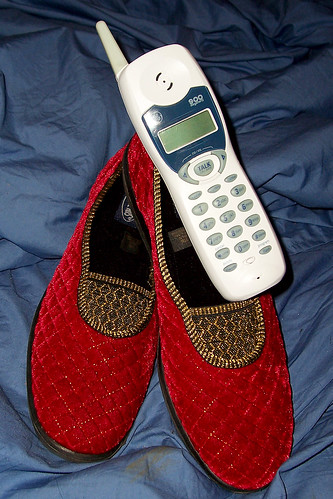
ruby slippers and phone by gwENvision
I do not know if you have noticed, but the world is full of underemployed coaches. Go to almost any networking meeting and you are sure to meet one or two coaches a little too eager to explain how you can be and achieve so much more.

I am curious about this. It is partly a result of all the hype. There has been so much hype about coaching. In France the word hardly means anything. If you are not sure what the word for a coach is in French it is le coach (and yes there is also le coaching). It covers everything from personal trainer, to personal shopper, with some potential for psychologist thrown in.

I blame the training organisations. For years now training organisations have been telling people ‘Coaching is the fastest growing profession in the world…’ with all kinds of promises of being able to earn hundreds per hour while sitting in slippers at home and asking open questions on the phone.

What happens is that people take a training, get hooked on the heady rush of watching people become aware of their deeper desires. Then they get business cards made, some really comfy slippers and a new phone, and then….

…then they find it is not so easy. They head to their local networking breakfast and meet a bunch of other coaches with cards and whose slipper softened feet are struggling with their business shoes. Eavesdrop on the conversation between them and you'll hear allusions to abundance, cooperation, and it 'not being a zero sum game'. Watch the body language, you'll see their eyes scanning for the signs of eligible clients and their thighs tense to pounce.

The next step for these people is to do more courses, to unleash some more potential. Some coaches end up taking so many courses that they decide to teach courses and sell the same attractive dream of slippers and phones that they fell for however many trainings ago. In a gold rush the people who get rich are the ones selling shovels.

But isn’t that what we are doing at NLP School Europe?

Well we do talk about coaching, and we do train people who are coaches. Quite a few coaches come to us because they recognise that NLP underpins many coaching training courses and and they want to better understand the core of their technical base.
In fact I really like training coaches. They often understand what we are doing very quickly, and come back with great stories of how they have applied NLP with their clients.

The difference is we want people to apply NLP I their lives, not make NLP their life. We do not want our trainees to pack in the day job and set up as coaches. We are selling tools, not necessarily a new career.
Here is an analogy. Some years I remember a friend saying that in an ideal world there would be no Green party. All political parties would have integrated an ecological, sustainable agenda. Asking a politician if they were green should be like asking a fish if they could swim. Pretty self evident, and not really a question worth asking.
Back then the sustainable agenda was mostly talked about by people with long hair, and dismissed by people in politics.

Today we are closer to the ideal situation. If you ask pretty much any politician if they are green they will answer 'yes'. The difference between the politicians and the fish is that the fish are telling the truth. Watch the body language, the fish really can swim.

Actually that probably applies to most of us. When was the last time you checked your ecological footprint?

A bit of my own agenda creeping in there, again. Skip over it if you find it clashes with your own worldview. In another few years it will seem very dated anyway. At least that is what I am working for.

I believe that coaching is a useful profession. The ability to work with people in a respectful, compassionate ways is very important. The capacity to look to look at what is important, in a deep rather than superficial way is also vital to our society. An ability to integrate our values with our day to day actions and effectiveness is equally important. All of these are the promises of coaching.

But the ideal is that they would be integrated into our lives. That we would not need coaches for this, any more than we would need a green party.

So whether you want to be a coach or not there is something valuable to be had from coaching training.

For all the underemployed coaches, some of them will keep plugging at it and find a way to get the clients that you want.

Some coaches will hang up their slippers and go back to what they did before - but differently. Others will discover actually that what they really want to do is not coach, but something much more juicy, at least to them.

If you've just met an underemployed coach, and think they may have something to offer, but possibly overpriced,then haggle with them.

They could probably do with the practise. Some of them are not so sure of their skills yet. Give them a chance, they might well be very good. If they do a good job then they may well have created a regular client and a source of referrals. If they do not do a good job you will probably at least have enjoyed some interesting conversations.

For the underemployed coaches among you, haggle back! Do not give your coaching away for free. Make sure you get an exchange which is satisfying to you, even if not financially.

How do you know if it is worth taking on an underemployed coach. It is probably not good to do it on the basis that you feel sorry for them. Better to do it on the basis that there is something that you've always wanted to do, but never have yet. Perhaps there is a nagging sense that you could do better in some way, or some kind of difficult situation at work or at home that seems stuck.

If that is true for you then the next question is to ask which kind of coach you would like? Perhaps you will decide prefer the investment in an experienced well employed coach with fixed rates.

Alternatively you may decide to sponsor new talent. You may prefer someone underemployed, inexperienced and negotiable. In which case just head to a networking meeting and watch the body language.

Saturday, 27 January 2007

5 years more - perspectives in time

Notre Dame with flying buttresses - photo by scaredsquee
A friend and Yoga teacher Gary Carter once told me a story. He had been in a class where they were practising the lotus posture in a headstand. The woman next to him kept falling out of the posture and giggling, then getting back up giving it another go and ….. not quite making it. Somewhere between giggling and picking herself up the floor she would say to ‘another five years’.


She was about 80 at the time.

Our perception of time can make a huge difference to what we do and what we achieve. The question is, what is a long period of time for you?

Probably that depends on the context. Arriving at the post office, seeing a line of slow moving people can make five minutes seem looooong. Arriving at an office with a full task list to be completed for a much loved, and rapidly approaching project can make eight hours seem short. Our perception of time can vary immensely.

The significance of an event shifts with the passing of time. What makes us cringe with embarrassment one day, when remembered several years later becomes trivial or funny. Some day you’ll look back at this and laugh…why wait?

Culturally we have a tendency to look at our projects in terms of years, and rarely more than one generation. Compare that to the people building cathedrals. Down the road from me is Notre Dame, which took 185 years to build, or approximately six generations of labourers and craftsmen.

Lord John Brown re-branded BP from British Petroleum to beyond Petroleum on the basis of the question 'What will BP be doing 100 years from now?'. Petrol was not part of the answer.

Recently I read a book written about a Native American who complained ‘The white man’s culture steals from his grandchildren to give to his children.’ Which is an interesting statement from an NLP point of view. It acknowledges the positive intention – being a good parent, without condoning the shortsighted nature of the behaviour.

As someone interested in Sustainable development, based on a fascination with biology it is easy for me to have a sense of inevitable planetary doom. For all the changes of heart and environmental initiatives, it may be too late for us. We may well have upset the balance of the planet enough that we will wipe ourselves out, and many, many other species at the same time. We may be in the space between pulling the trigger and the bullet arriving.

However, even if we wipe ourselves out, even if we destroy every complex eco-system on the planet, in a few tens of million years life will have built itself up to a new flowering of diversity.

Sometimes when my daughter draws on a chalkboard, or her etch-a-sketch she cries if someone wipes out her pictures. Mostly she erases them gleefully, and gets to work on the next one.

In that perspective global extinction is just the planet getting ready for some more drawings.

But how can we apply these philosophical ramblings, apart from having some comfort in the face of inevitable loss?


All these perspectives, from five seconds, to five billion years are perceived in the present instant of our subjectivity. The problems start when we get stuck in an inappropriate perspective. Either too long - 'well all I do is ultimately insignificant in the vast expanse of time.' Or alternatively too short 'just one more beer...'

Or thinking a five year project is a failure because of the events of a single week.

There could be situations in which those events definitively kill the project, but given the greater space that perspective over years offers can turn the sense of the unfortunate events into a learning experience, rather than a defeat.

To practise flexibility in time perspective, you can deliberately exercise it in relation to decisions. I'll write it as a step by step exercise, but once you get the principles practise it as you like.

1. Think of a particular project or decision.

2. What will your perspective on it be in one week year, in five years, in ten years, by the end of your life, in one generation, in three generations, in the proverbial seven generations.

3. What about from a perspective of millions of years.

4. Consider these different perspectives. Do they give you new information, or a different sense of the project/decision? How does the decision/project match with your values or sense of life mission?

Can you get a sense of balance between the different perspectives?

5. Returning to the present moment, what seems right to you now?

It seems paradoxical, but taking these multiple perspectives regularly helps me stay more present. It helps me be more present, but not necessarily in an opportunistic ‘live for the moment' sense.

Rather present to enjoy the moment. The sun shining in through the window and illuminating my hands on the keyboard, the ache in my back, and a sense of openness in my chest that is warmed by the same sun that falls on my hands.

So wherever you are present reading this now, ask yourself if there is some perspective of time that you have been ignoring. Taking that into consideration, what is important to you now?


Tuesday, 23 January 2007

Three freedoms

photo of Freediver at the North Pole by Fred Buyle, www.nektos.net


Recently I was chatting with a coach, who observed 'Whenever anyone mentions freedom in relation to a goal, they are motivated in an away from direction.'

I agree that often people want freedom as an away from, I also think that we can distinguish three kinds of freedom.

We have already looked at the first one - what I call freedom from. As a motivation it can work pretty well. People ache for freedom from war, injustice, poverty, their boss, their job, their spouse(!). You can probably think of quite a few variations, and think of the lengths people go through to escape from the constrictions of their life or society.

Then we also have what I call freedom for. Which can you can also think of as freedom to. Freedom to love, to sing, to dance, to dream, to act. Again you can add in what you'd like to freedom for.

Finally there is simply freedom. I think of this as the ability to simply be in the present moment, accepting whatever is there, neither trying to get towards something, nor get away from something.

I realise so far I have defined this freedom as a negatively. It does not make it an away from. Towards and away from cease to mean anything in this state. I think of it as beyond towards and away from.

This kind of freedom is not something that can easily be talked about in words.

What has this got to do with NLP? I suppose this freedom is a state, and NLP has a lot to do with moving through states, becoming a connoisseur of states. In this state the old rules are suspended, perhaps removed. NLP values flexibility. In developing the flexibility, the ability to suspend rules is a useful skill.

It is a state that has been pointed to in many traditions through the ages. In yogic contemplative practise people talk about 'not this, not that'. In Zen they talk about cultivating doubt, the ability to doubt and go beyond a limited sense of who you are.

I could think of many worse ways to spend some daily time (or daily timelessness) laying aside desires, fears and even identity. Some people get scared by this idea, who will they be? What will the point be?

But in my experience we usually find our lives, habits and identity still there at the end of practise. Still there, but with greater choice as to what to do with them. Old motivations drop away, like clothes becoming looser and finally falling off. At the same time we get sensitive to deeper motivations calling. With that comes the possibility of deeper satisfaction, deeper pleasure and deeper happiness.

If we do not spend time doing this how can we examine where our motivations, our freedoms from and freedoms for come from? They might be from parents, from friends, from peer pressure, and from advertising. They might even be, heavens forbid, from NLP teachers!

Do you know what you want freedom from? What you want freedom for? and when you are free to accept exactly what is there, what is there?

Monday, 22 January 2007

Stories, Commentary and opinion

Stories are a basic unit of human communication, and so you will find them as part of many NLP trainings. This section contains links either to stories, or ways of using stories.

NLP is sometimes defined as the study of the structure of subjective experience. NLP recognises that being objective is challenging for human beings.


Since I do my best to own my subjectivity I try to be honest and transparent about it. I find that makes for clearer communication, if not always a jigsaw fit of agreement. You will find my opinions in this section, as well as anecdotes and metaphors.

Take with a pinch of salt and enjoy.


the fool in the laboratory

presenting NLP,I knew someone who...

the French attitude to Sects

Intoxicating new years resolutions

Paris Sans Clopes – the energy of habit

Three freedoms

5 years more - perspectives in time

Underemployed Coaches

politically correct for you're a *****er

Living treasures

Friday, 12 January 2007

Intoxicating new years resolutions


It is January, 2006 has clicked into 2007 and the champagne bottles have been dropped off to be recycled. It is resolution time. So here is something I wrote with the aim of offering you your heart’s desire this year – or at least a method to identify and develop it.

Keep reading and you will find a set of ideas and instructions. You can try them on your own, or what is more fun is to get a group of friends together and try it with them. Actually they don’t even have to be friends, just people you know. But be warned, you could have a magical time doing this and find yourself with a bunch of new friends.

Before you get on the phone to your friends here is the basis of the method. Often we start making our resolutions based on what annoys us. Because we feel frustrated at not having done something, or because we keep doing something that we (or others) think that we shouldn’t.

What I propose here is something else. Rather than starting with a unfulfilled desire, I’d like to start with an experience of something that you value deeply. The way into that experience is through stories. Stories are a basic unit of human communication, and they allow us to access states, emotion, motivation and information in a way that more ’rational’ methods fall down with.

Stories are best told within a group, and that’s why I suggest doing this with friends. The presence of your friends makes what you do much more real than the presence of a notebook. It is a privilege to be able to offer the same quality of witnessing back to them.

As you follow the steps, you will ideally enter a shared space with some really pleasant qualities to it. Operating from this space will allow the dialogue and scripting below to flow more naturally.

From stories into values
Tell yourself, your partner or your friends a story about an experience that you value in some way, a story that is special to you

When you tell the story, let yourself re-experience it as fully as you can. Three or four minutes should be enough.

It doesn’t have to be an epic tale. One of the last ones I chose was about the pleasure of taking my daughter on the back of my bicycle. Someone else told a story of learning excel with ease, instead of frustration. Of course there were also stories of moonlit coral reefs, helipads and luxury.

At the end of the story your partners can ask:


‘What was important to you about this experience?’
or ‘What is it about this story that you value or is special to you?’

feel into the answer, and give it simply without a huge discussion.

When asking these questions be minimalist. You ask them to help the person to go deeper into their own experience, rather than explain their experience to you. Frankly it doesn’t matter whether or not you understand their experience or not, just that you witness it with as much presence as you can.

You may come up with words to label your values. For example excitement, or connection, or contribution, or love. Make a note of them if you like.

Once you do this allow the next person to tell a story and repeat the process, and cycle through the whole group 2-4 times.

Since each story with its appreciation will take about five to ten minutes you may want to keep the groups small, unless your are happy to do this for hours. But since this is likely to be a very pleasant experience you may want to take hours!

At the end of this you will each have a series of values, not just as written words, but as feelings, images, sounds from the memories of your stories and elsewhere. You may notice certain themes and patterns that repeat between the stories, which may represent especially important values for you.

Those values won’t be abstract concepts, but something you can be aware of living in the moment.


Values into the future
Now is the time to start turning these values into goals. Get your partner to start going into an imaginary future that is an expression of or in line with their values.


Before you do this imagine all the pleasure you are experiencing in the moment (and which is an expression of your values) moving into the year ahead. Take a few moments or minutes to do this.

For me this was a bit like inflating the time line of my future with wonder, connection, gratitude, curiousity, love, and service. That may not make any sense to you rationally. It doesn’t have to. But the important part is that it makes perfect (if non rational) sense to me, as your version will to you.

Now start exploring that rich future. Do this by asking yourself or your partner

‘Allow yourself to float into this future filled with (state values) where you are living as an embodiment of (state values)

When you ask this of your partner use their exact words for their values - it will be much more powerful for them that way. Again you don’t have to explain or justify this to anyone else, just experience it as best you can. Be present and witness.

If you like you can add in a discrete background patter to support their exploration, something like this

‘and in this time you are living as an expression of (state values), what do you see around you that shows you that (values) are present now.’ Repeat this with hear, and feel.

In doing this you get an increasingly detailed picture of a goal, or moment in this valuable future. But you may also be happy to have a hint of what lies ahead, with the details implicit, the exact surprise you want, for you to unwrap through time.


Goal ecology
If you wanted that goal, that situation from the future, so much you’d have it already. The situation your are already in has benefits that you may have to give up, or reorganise to get to where you want to go. In your desire for this delicious and juicy future dripping with the bliss of your values you may have missed something, something important about the way things are now.


I doubt you want to throw away your curret benefits, the positive byproducts of your life now. So ask your self or your partner if it’s ok to have this now, and be alert to signals from yourself. Sense if there is something, whether it is rational or not, is impeding your goal. It could be that you think something, say something to yourself, see something, or that you have a feeling somewhere in your body – possibly of closing off or clamping down.

If there is nothing, great. If there is something, great! Because now you have the opportunity to work with it. If it is some rational idea then you can work with it rationally. I won’t go into how to do that now.

If it is more metaphoric, something felt, perhaps a critical or disbelieving voice then you can treat that as a ‘part’ of yourself that you can communicate with. One presupposition of NLP is that every behaviour has a positive intention (for the person engaging in that behaviour), and the same applies to working with parts.

So greet that part with gratitude and ask something like this

‘Hello, and thank you. I know you’ve been doing something for me, something important, something valuable, and I’d like to know what it is. Can you let me know, what’s your highest, most important intention for me?’

Many times people get an answer like ‘to stop you looking silly’ which may well have the intention behind it of ‘security’, or ‘good connection with people’ or ‘confidence’ or a combination of these. When you have your answer you can negotiate. Ask:

‘Thank you for letting me know that. I value what you want for me, and can you find a way that we can integrate this in with (state previous values) and (the goal).’

All of this can be done internally. It can also be facilitated by a partner, who asks the questions with that quality of presence and benevolence.

The ability to work with parts like this, and harmonise their positive intentions with a goal is a fundamental skill of an NLP. It is found in a great many techniques. It uses non verbal communication, linguistic patterns, modelling and more. I don’t really have time to do it justice in this article. Better to get a direct experience at a training or with an NLP coach. You can read some more about parts and positive intentions in the Encyclopedia of NLP

Next steps
Now you should have a value driven, ecological goal. You can begin to embody the goal, to be the goal ask

‘If you are an expression of (values) now, how will you sit, look and talk? Allow it to move through you now, and show me in your posture that you are (state values) ’

The idea is that you rather than having to make lots of effort to get your goal, you move towards it easily, anything you need to ‘do’ to get there just happens naturally as a result of who you are. In fact if you do this you are your goal.

Once you or your partner have done this then you can ask:


‘Now as (state values) what is the next things that you can do in service of (goal)?’

It could be something that has direct relevance towards what you envisioned, or it could be something apparently unrelated like going to see a film, phoning an old friend, or taking a walk in the park.

The point is that whatever you choose you can do it as an expression of your values. This way the ends do not justify the means, the ends and the means are one.

All you have to do is keep living in this way…Of course you may get knocked off track and out of state. That’s life giving you more opportunities to deepen your capacity to live your values, and calling you to develop new ones.

But that’s enough reading me for now. Much more interesting are your stories. How are they important to you? What state does reliving and going into the value of them put you into? Who do you want to share them with?


Wednesday, 27 December 2006

the French attitude to Sects

Most foreigners in France will at some point notice that this country has a suspicion of les sectes – what we tend to label as Cults in English. If you are reading this as a foreigner then you may well say to yourself ‘ fair enough I don’t like those brainwashing weirdo’s either!’

What you may not appreciate is that this attitude extends far further, and far more often than it is in America, in England or any other European country. France has an official list of sects, which includes the usual suspects (Scientology, the Mooneys etc) and plenty of organisations I have never heard of, but also groups accepted as probably benign (if sometimes bizarre) like the Jehovah’s witnesses, and Transcendental meditation.

Apart from an official list, and laws to back it up the suspicion of sects runs broadly throughout French Society. I have friends in martial arts who are often asked if they are part of a sect. Then again if I think about it doing movements originating in China, then hitting each other is in many ways just as bizarre as chanting words in strange languages -whether Sanskrit, Japanese, or Latin. When I told a client I was going to a an alternative medicine salon and he told me to be careful because ‘those acupuncturists belong to sects.’ Mmmmm….

Now I’m going to do something quite unusual in the realm of NLP. I’m going to write a little about why I think this is so. It’s naturally relates to the nature of belief and if you have ever been eyed suspiciously for carrying a Yoga mat you may be curious as to why…

It all dates back to the French revolution and the imposition of the laïcité. In taking the immense and courageous step of aiming to thought, philosophy and progress from the control of the Church there was a strong desire to remove Religion from France altogether.

However strong the desire it is not such an easy thing to wipe out centuries of belief and culture. People have tried since, in Russia, China, Cambodia and no one has yet succeeded. Napoleon was wise to this. He did not want to have to fight a war against religion at home while he went off empire building. So he made a deal with the representatives of mainstream religion – the Catholic Church.

He gave them the responsibility to report of any new religious groups that might represent a threat to his power, and the authority to cooperate with government to deal with any such threats arising. He based this on the Catholic division of dioceses, a préfet de police supporting each Bishop, and the chief of the local Gendarmerie working with the parish priest.

Spool on a couple of centuries and you have the situation where anything that falls outside of the cosmology or theology of Catholic thinking is regarded with suspicion. Actually much Christian thinking is regarded with suspicion as well. France is a laïcité after all.

In the Academic world actual research and investigation of unorthodox religious organisations is discouraged. An academic here attempting to write a serious treatise on such an organisation is likely to be labelled as a an apologist for sects, and lose their post. The basis on which a sect is designated in France has been attacked because of insufficient research combined with unchallenged negative bias.


If you'd like the long version of this story I recommend the following link, with this story from the Montreal Gazette for dessert.

Of course it’s natural that people find facts to support their beliefs. That applies to whether their beliefs are that the world is a random occurrence in a universe that is slowly running down, or that the world was created in 7 days by a deity with an impressively bushy white beard.

This relates to NLP because NLP includes a pretty good set of techniques that you could apply to setting up a sect. I talk more about people's suspicion of NLP here. Still, we are not always helped by journalists.


Recently on French TV there was a program in which unscrupulous salespeople were filmed swindling old folks by selling them services that they didn’t need. When asked how they had learned to do this they answered they had learned through NLP. Not great publicity for us, but probably a good reason to learn NLP to help deal with that kind of unscrupulous person.

Practically speaking there is not much I can do about this situation – except be scrupulously ethical in how I teach and use NLP. Acting like a relatively normal human being helps. Not that I know what the definition of normal human being is of course.

Occasionally I get mischievous, I’ll admit. People have asked me if I’m part of a sect and sometimes I answer ‘Yes! But my sect has a maximum membership of one. So you can’t join, Sorry.’ It tickles me to imagine extending that idea in a democratic way. To adapt the old saying goes ‘one man, one sect’. Of course if you are a woman you can have your very own sect too. I have not considered if there should be a minimum age for individual sect leadership.

I think a more interesting set of question is: If you were both the guru and membership of your own sect, what would your teachings be? Where might they have come from, and how are you following them?

Monday, 11 December 2006

Paris Sans Clopes – the energy of habit


Now if you are reading this outside of France the title of this post may not make much sense to you. Pretty much everyone knows what Paris is, but 'les clopes?' Clopes is colloquial French for cigarettes, and smoking (verb: cloper – to smoke). In February France follows America, Ireland, Holland, Norway, Montenegro and many other countries in introducing legislation to prohibit smoking in many public places.

Now the change in France is not going to happen overnight. Café’s and bars have a year’s grace period to adjust. But why am I writing about this in an NLP Blog? Well smoking is such a universal, experience and such a good example of a unwanted habit that we often use it as an example to illustrate certain NLP principles. So now that a whole country is aiming to get healthier I’ll take advantage of it here.

We use smoking as an example because there are a lot of people who want to stop smoking, but find it hard. One reason they find it hard is because they start off with a badly formed outcome in mind. They want to not do something. Well formed outcomes are stated something positive to be, do or have.

Wannabe non-Smokers are also at war with themselves. They usually have a string of reasons for smoking as long as their arms. But they are rarely aware of more than just a few of their reasons to smoke.

These are what we call the positive intentions of smoking, and typically include having a treat, having a break, punctuating the day, a way to start a conversation and part of a sense of identity. People often say that they are smokers, they define the world between smokers and non smokers.

If they do not address these positive intentions then in stopping smoking they find themselves missing out on a whole host of what makes life good for them. They don’t know how to have those intentions can be fulfilled in all sorts of different ways.

Not only do they have all these hidden reasons to smoke, they also have a lot of beliefs about smoking. Nicotine is very addictive, giving up is hard, and each time they light up after a period of laying off they consider themselves to have failed.

So now France is in the same position as many of those people. Smoking is (decreasingly) a part of the French national identity. Many Café’s have a tabac, a counter where there is whole range of tobacco products on sale – as well as stamps and lottery tickets. For many people sitting at the zinc counter of a café, ordering a coffee and lighting up a cigarette (perhaps a Gauloise) is a quintessentially French activity.

That is all under threat. That part of French culture is going to die, and people on the tobacco side of it are nervous.

Personally I’m curious. Not just curious, I’m looking forward to it. It’ll be great to be able to drop off my daughter at school, and have a cup of tea in café which has clean air. I’ve seen it happen before in other countries, in houses and households, and I've liked he results.

But when you are on the other side of that change, it can see strange and daunting. Like going from childhood to adolescence, or adolescence to adulthood.

Paris has already started though. I see a smaller proportion of people who smoke, and a general cleaning up of the city. For example there is much less dog mess on the street than when I moved here 6 years ago. Not that I want to draw any parallel between dog shit and cigarettes for the smokers among you. I mean what would you want to clean first, your fingers or your lips? Please don't think about that whenever you see a cigarette, it might spoil your pleasure.

The reality is that this kind of change can be easy. There are moments that people recognise that something does not fit their sense of identity, that they have moved on and the old ways are no longer necessary.

People readjust their actions when they examine their values. I know that when I stopped smoking one reason was I didn’t want to pay my money to companies with a long history of deliberately lying to sell damaging drugs to large sections of the population. What’s the word for those people? Scumbags I think.

No, that’s not very compassionate of me. People knowingly trying to hook other people on carcinogenic chemicals aren’t really murdering scumbags. They are just misguided and doing their best to make a living. Just like arms dealers, and the rest of us embedded in a society that invests money in destructive unsustainable activities. At what point do people own up to what they are doing as wrong?

But rather than getting all angry – which sometimes is justified and a useful motivator, we can also turn towards something more positive.

Something else that helped me leave cigarettes in my past was having something else that I really wanted to do. Once I discovered freediving I lost all desire to smoke. Images of myself playing in the ocean wiped out any temptation. We all have dreams that can motivate us.

Someone at a French NLP training I attended recently gestured to a non-smoking sign. It was the usual crossed out cigarette. He stated that there was no other way of giving the message of no smoking.

I disagree. Representing a positive goal that is not compatible with the unwanted activity would work. So a picture of blue skies, or mountains, or a windswept ocean with the words ‘keep the air clean’ or ‘enjoy a breath of fresh air’.

So you may not smoke, and you may not live in Paris – if you do both of these then you might think of visiting Mike Fink (Mike's site is in French and he also works in English). But you may have some activity or habit that gets in the way of what you really want to do.

When you talk with someone who admits that they want to give up their habit, it can be helpful to motivate them to change by kicking their ass, by pointing out the negative consequences of continuing as they are.

I also find that it’s helpful to recognise that even scumbags have reasons to do what they do. If I am going to help them find a new way forward I’d better have a sense of how to incorporate those reasons into any new plan, or way of being. It’s bit like blending with and using people’s force in martial arts. It makes life easier, less violent and takes the existing energy and channels it in a new direction.

So where might you have some energy that could use re-channelling? It may not be a conventional bad habit like smoking. It could be something as subtle as thinking negatively. Then the next question is, once you have freed that energy where would you like to see yourself put it?

Monday, 4 December 2006

presenting NLP,I knew someone who...

If you’ve been reading this blog I like to think you have gone beyond the view that NLP is manipulative. You may also have added some arguments – or reasoning if you prefer that term to answer people who have that as an accusation.

The next question is how do you talk about NLP at dinner parties without attracting flak or putting people on the defensive. The problem here is that NLP is a little too good. What do I mean? Well NLP promises the ability to improve just about anything. That covers relationships, communication, performance, learning, sex and any other area you think about applying it to.

However, for many people suggesting that they can improve something in their life implies that they are not good enough. It’s a slap in the face that can put people subtly on the defensive, or actively on the attack depending on their character.

Recently an intelligent French student of ours was telling us how his friends have noticed that he is different in some way, and they are intrigued. But they are also wary because NLP comes from outside their Cartesian frame of reference. They ask questions, but distrust the answers, especially when he talks about what NLP could do for them.

So in the conversation we thought a different way of presenting NLP would be helpful in France. It has some parallels with those people who ask the doctor about a problem their friend has.

So instead of saying ‘NLP can improve your ….., and make you happier, healthier etc’ it makes more sense to recount personal experience of how NLP has been beneficial from a 1st person perspective ‘Since I have started NLP I have…’

You can also use third person stories ‘There was a person on the course who…’

That way the listener is less likely to get defensive and argumentative. Less likely because if you present something sufficiently alien to their model of the world, they may tell you what you saw and experienced never happened.

Self referentially, I could talk about how NLP helped me make the transition from a martial arts instructor, to a trainer and coach. It was something that I had struggled with because I didn’t recognise where I was caught. I identified myself so much with kung fu identity that I hardly noticed when the way I presented myself lead to people asking me for martial arts classes rather than NLP coaching. Once I made the connection, I asked a coach to lead me through a technique. Then the change happened quickly and easily.

A lot of people do get caught in transitions. Either they are not sure how to take the first step, or find themselves frozen between different ways of functioning. Most people I know have dreams that they aren’t living, or taking steps to put into place.

We often see people in our trainings who are unsatisfied by their work. Somehow their job doesn’t match their values, the way they see themselves, or put themselves in a position to really offer their gifts to the world. When we see that one of two things usually happen. We have seen some of them decide to leave their job, which is probably a good thing even if seems tough in the short term. Effectively they were only half present at work – it’s hard to be passionate about what you don’t believe in.

We also have stories of others who begin to apply their knowledge to change their working environment. That way they not only apply themselves more enthusiastically at work, they also begin to create the kind of working culture where their colleagues can be more present, more passionate and more effective.

Some people love to help others, without necessarily wanting to become a professional helper. In which case, I could talk about how some years ago I’d spend part of the summer teaching Taiji at a Yoga centre in Greece. One of my my activities in between sessions of Yoga, freediving and teaching was finding out who had a phobia of water and dealing with it. Since I love swimming it was particularly satisfying to watch them come back from the beach exhilarated at the aqueous world that was opening to them.

For people motivated by the desire to succeed in more conventional terms we have reams of stories of how people have rigorously applied NLP in different areas. I can think of several students who used NLP techniques to prepare for presentations, then winning competitions or receiving standing ovations. Others have adapted their techniques and created tools that they use that improve their customer’s satisfaction and loyalty.

So rather than offering something frontally, the idea is more like two tuning forks resonating together. Pick something that you have an intuition might appeal to the listener – and use your NLP skills to refine the precision. Then as you tell the story your listener may well be thinking ‘That’s something I could do with changing too.’

It's also a useful exercise to list or learn from sucesses, whether your own or other people's, whether in NLP or in other fields. It can help to keep grounded in an optimistic state, and also provieds examples, anecdotes and stories that can help spread those states to other people.

So I wonder what have you seen working (recently)? Where else could you use some of that, and who else could benefit from something similar?

Sunday, 3 December 2006

the fool in the laboratory

Several years ago I was in a small park in Paris talking to the fool. The sun was shining on an ancient acacia, while undercover police were sneaking around to leap on a couple of lads smoking something more fragrant than a cigarette. A large group of teenage tourists from Portugal were joking around with each other.

Before I carry on I should introduce the fool. He got his name through an accident of birth. His life is a series of radical experiments, financed by the large fees he charges some of the world’s multinational companies for his coaching and consulting services. Funnily enough it’s the effects of his bizarre experiments that make him desirable to his employers.

He once stated proudly to me that he had been fired by all his major clients because he was committed to speaking the unutterable, and was willing to make a mess that employees of the companies were unwilling to do, if he thought that it was of service to do so. All of them had rehired him later on once they had realised the value of what he had said. All of them except one – a major department of the US government. They changed their minds and asked him back a couple of years after he told me that story. I suppose government bureaucracies often react more slowly than multinationals.

Though not a Buddhist, he is not afraid to talk about the roles wisdom and compassion to chief executives. He can do this partly because he is not afraid of being fired. Also because at the levels of management he works, his clients are very intelligent, very experienced and recognise linear thinking often doesn’t create the results they’d like. They appreciate that to look outside their usual sources of understanding and decision making is essential to keep progressing, and the fool lives far outside their frame of references, but can also speak in their language.

So we were in the park and the fool was recovering from an experiment which had exploded. Emotionally, it had had left him a little bit like a cartoon mad scientist staggering out from the smoking remains of his laboratory, clutching a test tube and with frazzled hair sticking in all directions.

After a period of silence he said wistfully "Ed, you know if there is one thing I’d like to have understood earlier, it’s how the way you are from moment to moment, over a period of years, creates your life."

I nodded. I was trying to work out where the fool lived. He had stuff in storage i

on a number of continents, I wasn’t sure if he had an apartment somewhere, or several, or who was living in them. To some extent he finances other peoples radical life experiments too.

"But I didn’t realise back then, and now I’m living with the consequences of years of the accumulated habits of thought and their results."

I nodded again and gestured to the young Portugese tourists ‘Do you think if we told them about this they’d listen? Unlike you," I teased, "it’s not too late for them."

The fool shook his head sadly.


"But what if we told them that if they paid attention to their moment to moment state of being they’d get laid more. Perhaps that would get their interest?" I don’t always raise the tone of the conversation, but to the fool, sex, death, business and spirituality are all so intimately linked that I can leap from any subject to any other and I know he’ll follow the thread.

He perked up for a moment "Well that has a better chance of getting their attention. I know a spiritual teacher who talks about sex for just that reason." After that he told me how he had an escapist habit of reading ancient Greek philosophers and proceeded to discuss the cosmological mode of a particularly obscure one with me.

I understand what he means about the moment to moment way of being. On the one hand it’s obvious. Spend four hours an evening watching TV and you probably won’t have much time left over for developing skills, doing sports, building your business or keeping up with your friends.

But on a shorter timescale our states and habits of thought also affect us. How do you track something as ephemeral, and as seductively involving, as a thought?

Well there’s a very old answer to that question, meditation. Taking some time daily to bring the attention back to a simple part of physical awareness like the breath can create a distance, a perspective that allows you to observe the act of thinking. It has some great measurable physiological benefits as well (lower blood pressure, and a decreased risk of Alzheimer’s disease among others, click here for a more comprehensive overview).

Of course meditation is not strictly speaking part of NLP, but the two are related in some ways. NLP has been defined as ‘the study of the structure of subjective experience’ and meditation is all about the observation (and possibly transcendence) of subjective experience. I certainly consider the two complimentary.

So while meditation is a great exercise to create distance between thought and awareness, NLP has great tools for acting on thought itself. The original language pattern of NLP, the meta-model, is all about teasing out the ways in which thoughts channel our attention. The meta-model provides an intelligent system of questioning to open the thinking, so attention can be paid to what’s more important.

It’s an interesting exercise to spend some time writing down or recording yourself talking about some set of issues in your life. The writing, or recording gives some distance, rather like meditation. Then you can look through to see the patterns of meta model violations in your language, and begin to ask questions, open up the fields of your awareness.

The fool may have wished that he had realised the importance of how his way of being from moment to moment created his life when he was younger. The aliveness and the intensity of the realisation he shared that day was the result of years of work, observation and experiment. I understood what he said, but I suspect the fool understood at another level to me. We can continually get to deeper, or higher levels of awareness and apply them to daily reality.

Perhaps in twenty years time we’ll be in park in Portugal watching a group of middle aged French tourists and after a period of silence he’ll say "Ed, you know if there’s one thing I wished I realised when I was younger…"

In the laboratories of our lives the experiment has already started for all of us. What results are you getting? Is it time to change the nature of how you are experimenting?