Showing posts with label Techniques Methods and Practises. Show all posts

Monday, 12 November 2007

Injunction scans

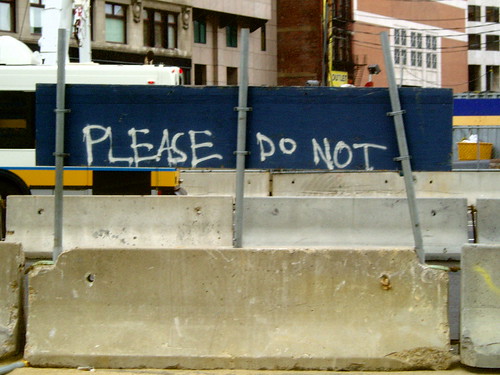
photo: civic injunction by jbartok


I believe it was Timothy Gallwey, the father of executive coaching who originally said

'performance equals potential minus interference.'


He first used this idea in a sporting context, especially with reference to athlete's doubts, distractions and negative internal dialogue.

But for the purpose of this article I want to apply this principle not so much to individual performances, but to the larger scope of what people decide to perform in.

People usually perform the best when they have a maximum of enthusiasm. They also seem more dynamic, attractive and convincing to others when they are enthusiastic. Naturally I can think of exceptions to this. Enthusiasm is not a substitute for skill. But it often precedes and leads to skill.

Children often show great capacity for enthusiasm. At least when they are left to play. Adults often show less enthusiasm. Somehow in the civilizing process education can damp down enthusiasm.

Let me give a personal example from that messy ground between being a child and an adult.

As a teenager my dream was to go to Taiwan and study Chinese martial arts as my Taiji teacher had done. My parents did not really understand why this was so important to me. They encouraged me to go to University and get a degree. Eventually I gave in, partly pushed by my parents, and partly lured by tales of student parties - something I could also feel enthusiasm for.

So I spent three years studying Environmental Biology, but my heart was not completely in the work. Biology fascinates me, whispering to me about the miracle of our interconnected lives. Despite this I did not appreciate what an amazing privilege it is to be able to choose to study a subject like that. At the time University seemed like an extension of school, but with beer, girls and scuba diving.

So after I graduated it was not long before I left England and found myself on wandering the streets of Taipei, knocking on doors and looking for teachers.

That's how I first met Luo De Xiu in 1991. He impressed me not just with his fluid power and skill, but also by his infectious enthusiasm for the arts he practiced. Sixteen years later he still lights up like a child when talking martial arts. A living example of how skill and enthusiasm go hand in hand.

Excuse me, I am digressing a little. My point is that I had been temporarily deflected from what I felt truly enthusiastic about. Once I got back into the groove of what was important to me, my life was felt magical and my energy soared, not just when I was in Taiwan, but when I was on my way too. I hope that you have had some experiences, made some choices that had this effect on you too.

Now my question is what interferes with us living more of our lives this way? What stops us going from what we really want?

I describe one kind of dampener as injunctions. These are rules, that come from different sources that say how we should and should not live. They can be subtle, or brutal. We often internalize them, so that we forget how they limit or potential options. They guide our lives, invisible and unquestioned. People live without enthusiasm for what they do, because they are unable to even see anymore what they are truly enthusiastic for.

So in the story above my parents injunction was something like 'good boys get degrees.' That one is fairly benign, and there is a pretty clear positive intention and assumption behind it - a good education leads to a good living.

But there are plenty of other injunctions. Often they apply to getting what we want.

My sister in law told me that in the school she went to she was discouraged to ask for things directly. If you wanted someone the salt you were expected to ask someone 'Would you like some salt?' to which they were expected to reply 'No, would you like some salt?'

Some typical injunctions include
  • It is selfish/rude/arrogant/greedy to ask for what you want
  • If you ask for something you will not get it
  • Saying what you want gives other people power over you
  • Good boys/girls do not do that
  • It is your duty to sacrifice
  • What makes you think you deserve...
  • People will be jealous if I get what I want
  • I will probably just be disappointed
I could go on, and on, and on...

Of course all of these injunction have some kind of positive intention. They are taught as a way of maintaining the structure of societies and families.

I believe that once we have the ability to to think reasonably, rationally and ethically then they are up for questioning. Society is changing with technology. People have higher levels of education than ever before, and given more choices I believe that people will tend to act more generously towards one another. A lot of the old injunctions simply do not apply anymore, and they certainly deserve the scrutiny of intelligent mature people.

So if you want to liberate some extra energy, widen your options, and charge up your enthusiasm then give yourself an injunction scan. Perhaps some of the ones above seem familiar to you. You can probably find others.

To find them ask yourself what you should or should not do. Think of the people around you in your culture, what are the rules they live by implicitly? Have you taken them on too? Contrast these with the rues of other cultures you may know, and what do you learn? Do the injunctions stand up in the light of awareness? What are their positive intentions, and can you find other ways of fulfilling them?

The more you clear your internal landscape of weeds like this, the easier it will be to see clearly what is important to you, to what you really want, hear it calling and feel the pull of it into the pleasure of bringing more and more of your gifts to the world.

And what do you really want?


Tuesday, 23 October 2007

Stillness and ideal movement

Photo: Baguazhang master Luo Dexiu demonstrates focussed attention with a relaxed, extended and balanced posture

I must be doing something right. Despite only writing here intermittently I seem to be attracting an increasing number of readers.

Anyway before I start patting myself on the back I thought I can offer you an adapted extract from the manual of a training I offer called Practical stillness.

The idea of the training is to distill years of martial arts and meditative training, combined with NLP to give people tools that they can use in communication, coaching, difficult situations and in decision making.

Ideal body use - martial arts and coaching

What we are looking for (not mention listening and feeling for) is the most relaxed use of the body possible. Emotions, positive or negative require tension and movement to express.

Being increasingly relaxed allows a kind of quietness, a stillness and a receptivity.

Also excess tension is both tiring, restrictive and wearing on the body.

If the body is relaxed the spine can lengthen and we can stand increasingly upright. The more upright the spine, the less tension is needed to stand, the easier it is to relax. Thus a virtuous cycle is created.

A simplistic biomechanical view of the body is muscles attached to bones, which act as levers moving around joints held together by ligaments. To an extent this is true, the reality is far more complex, and subtle.

A more interesting and accurate image is a dome tent. There are some rigid struts in the body, but they are held in place by sheets of fabric that balance tension in many different direction simultaneously. This allows the tent to be springy if pushed. Inappropriate tension in one part of the body is like pulling the fabric on one part of the tent. The fabric is only pulled in one place, however the whole tent loses its capacity for springiness.

In the body the tent’s fabric is not just muscles, it is multiple layers of connective tissue, under the skin, in the tendons, throughout the internal organs. The major lines of pull that these make map across loosely to the meridians of Chinese medicine.

Also all these structures are tied into the nervous system, which is also tied into the endocrine system, which baths every cell of the body in chemicals that effect the way they function.

How these systems all interact is beyond the scope of this article. Essentially making a change in one effects all the others, and the ones that are most available to work with are movement, and breathing.

When we return to an upright and relaxed posture the body becomes more receptive. The bodies of people around us leave subtle echoes of their postures and emotions in our own. To notice and work with these it helps to be still.

I remember a friend, a Karate champion who was discovering these sensations of sensitivity. He was more interested in kata (solo movements) than fighting. In fact he was completely fascinated by body movement. He had recently placed very well at a major tournament in which he had to fight, and since he did not like to fight this surprised him

He explained that because he was sensitive to the possibilities in his own body, he could read the possibilities in his opponent’s body, and thus predict his opponents next movements and defeat him.

For coaches and communicators being able to return to some neutral and sensitive state is extremely helpful in modeling the world view of others.

Of course you can second guess intellectually, and it is great to have intellectual models you can play with. If this is all you do though, you miss out on a very ancient and sensitive method of getting information. You will also miss out on many important channels through which people connect with each other

Many people equate sensitivity to other people's emotions as weakness, and in some cases spaciness. It does not have to be this way. Going via the body allows people to be both sensitive and grounded.

One of the reasons I choose martial arts as a model of ideal movement is that it is one area that places great demands on the body, the need to move freely, predict and act, and in which there is no space for overly weak sensitivity.

In martial arts the body needs to be able to accept impact while staying balanced, and transmit grounded force. The same characteristics that allow you to do this physically also map across very well to accepting emotional impact.

Developing this kind of body use takes some time and practice. There are aspects that can be realized instantly, and other parts that require the gradual lengthening of muscles and connective tissue. It all works best with gentle attention to key areas of the body - the spine, the pelvis and centre of gravity, as well as the flow of weight downwards, balanced with the support of the ground upwards.

So can you attend to this gently as you sit at your computer and read this blog?

Wednesday, 6 June 2007

a generous frame

photo: framed world by youngdoo


The frame with which you approach a situation will make a big difference to what you do and what happens. Here is another martial arts example.


There was once a martial artist who worked in the military. He trained hard, and was tough. he would also get into lots of fights. His frame in any situation was 'Am I the toughest person here?'.

This is a common attitude for people who have a skill that they are proud of.

I really appreciated this when chatting with a musician. I described an old internal dialogue of mine which went something like this 'Well he may be smarter/more charming/richer than me, but I could kick his ass in a fight!' He smiled as he listened and replied 'You know I do exactly the same thing, except I do not tell myself I can fight better, I tell myself I can play the trombone better.'

So when this martial artist walked into a bar he would eye up anyone he thought might pose some kind of threat in a fight. Not surprisingly many of these people were similar to him. Human animals being exquisitely tuned to non-verbal signals - especially those that suggest danger. The people he eyed up would perceive his presence as a threat. His attitude told them he was planning a fight, and they were the kind of people who were more than willing to oblige..

So there would be a fight, and someone would get hurt.

Many martial artists have a great capacity for re-framing fighting injuries as learning experiences by the way. They also use them as justification for training harder, being sneakier, more ruthless and hitting first so as to avoid further injuries (you can learn from someone else's injuries too).

One day this martial artist met a teacher who would change his life. The teacher gave him a different frame for his martial skills. Instead of being caught in the constant stress of 'Am I the toughest fighter here?' he offered him an alternative that meant that he did not have to prove and test himself at every occasion.

That frame is 'Everyone in this room is a little safer because I am here.' Now his martial arts training is about contribution, rather than survival.

So it is interesting to think what kind of frame you put on different situations. when the frame is around proving yourself, not making mistakes, maintaining distance,or not looking stupid then there is a good chance that you are in for a hard time.

Change the frame to how can I contribute, or how can I learn, or how can I have fun, then both the perception of the situation and your actions are likely to lead to a very different result.

Sometimes making a change is as easy as recognizing a destructive frame, and putting something more pleasurable in its place.

What are your favourite destructive frames? What would you like to change them with?

Monday, 4 June 2007

Cycles of work and strength

photo: Calderwood tree stump by Auchinoon


Some years ago I used to work as a personal trainer, and at the same time competed in full contact martial arts tournaments. Both of these activities required a level of fitness, especially the latter.

But however fit I wanted to be I knew that I couldn't train 24 hours a day, even if I was not training very hard.

To maximize the effects of my training I took another approach. I trained very intensely, then rested intensely.

What I told my clients with respect to exercise was this. You do not get stronger when you train, you get more tired and you get weaker. You get stronger when you rest, which is when the body adapts to the demands placed on it during training.

It applies when recovering between sets of an exercise during a session, as well as the periods between sessions. There are longer cycles of rest and recovery as well.

The same is true of non physical activities. Work too hard, do not rest and it results in burn out, and loss of effectiveness.

Many hard working people would like to be more productive. They try and fit more and more into the day, and cut out periods of rest. For many of the people I coach they benefit from keeping the rest periods, but improving the quality of relaxation.

Quality of relaxation is a skill. That is why so many people turn to Yoga and Taiji these days - to learn some of that quality. Breathing exercises and meditation are other ways to develop it.

Sometimes I catch myself half resting, half working, and not getting much done. I am making it a discipline to really go for my rest now, not even bother with a tea, but sit and relax. Sit and let go of everything. Maybe fall asleep for a few moments.

It is not always socially acceptable to do nothing, especially at work, but focused nothing is the purest form of rest, and can lead to the swiftest recovery. It may take some time to learn to relax deeply and quickly, but once developed it is a great ability.

There is a lovely Zen story that touches on this.

A master is lecturing the meditating monks 'If there is anything in your mind then throw it out.'

One young monk asks 'But what if my mind is already empty?'

'Then carry it out!'
the master replies

Daoist traditions use the image of being motionless, silent and inert like an old tree stump. Somehow that is an image that works for me, you can find what works for you.

So stop now for a moment, still yourself, and how still are you now? What else can you let go of knowing that it will be there when you come back?

Friday, 1 June 2007

Overlaying Maps

photo: Alum Rock Park Map - Google Maps Overlay by Victor Solanoy


A theme that I keep coming back to in NLP is
a map is not the territory. It applies on all kinds of different levels, two friends chatting and not quite understanding each other, two cultures not getting on, to someone lost somewhere because they cannot read a map - literally.

As people take on this idea they leave the certainty that comes from the knowledge that 'Science proves' or that 'the scriptures say'. It is not always comfortable for them.

Probably the majority of people that I work with are either moving into this area of uncertainty, or are already there. There tends to be a progression in how people structure their world views, and the relativistic map is not the territory one is fairly advanced.

Once people pick it up then they can often cross cultures more easily, and work with people very different from themselves more elegantly.

One of the ways to develop this ability is to deliberately take on, learn, and at least temporarily believe different maps. On our trainings we teach different communication models for exactly this purpose. The different models contradict each other. All of them are useful, but which is right?

Jumping between maps and models is great intellectual exercise, and as an athlete I like all kinds of exercise. With time it develops a higher level capacity to notice similarities in structure as well as content.

Partly with this in mind I am developing a blogroll with links to other blogs. These blogs have styles and content which can be very different from this one (though for now they are all blogs). You may follow some of the links and like what you read, or you may hate it, or be scared by it or a combination of these and other emotions.

My question for you - especially if you do not like what you read is whether you can take on the opinions of the writers as if they were your own and therefore true?

You do not have to spend the rest of your life believing what you read, just be able to take something else on for a while.

Monday, 28 May 2007

Fun with space

Photo: Power lines by shoothead


One universal human characteristic is the tendency to sort and organize our understanding of the world spatially. We are born into space and time, and our internal world is build around space and time too.

If you watch someone talking they will tend to gesture to where information and objects are in their imagination. Some of these gestures may be in corporal space - pointing to parts of the body when referring to emotions for example. Other gestures may refer to where they imagine events in the past or future to be, or to concepts that float somewhere in mental space.

As quantum physicists say time is what keeps everything from happening at once, and space is what keeps everything from happening in the same place.

There is a huge amount of information available for people willing to observe, and you it can be used in all kinds of ways, in teaching, sales, therapy, communication and influence.

In this article I am mostly interested in ways to use the tendency of the mind to code in space to explore characteristics or self concept.

For a long time in NLP people have used the tendency to code time spatially. A lot of people think o f the past behind them, or to the left and the future ahead, or to the right. Like anything else in NLP there are plenty of individual variations in these patterns.

This resulted in people explicitly laying out time as a line along the floor, which can be walked on to explore conceptions of the past or future, and stepped off to get some perspective on the whole flow of time. This has great application in planning, coaching and therapy.

Recently I stumbled across another related idea. You can code a quality spatially along a line. For example confidence, or patience, or playfulness. Choose what you would like to increase.

If you imagine a line stretching in front and behind you. Where you stand is your current level of whatever quality it is. If you take a step back that quality will diminish, and if you take a step forward it will increase.

To play with this I recommend starting slowly to explore along the line. Take a step back, and notice how your sense of the quality can decrease. Why back? Because most people find it easier to imagine regressing in terms of their desired qualities than progressing.

So take a step back, and notice the difference. Then take another step back, and notice the difference. Then step forward again, and again. Doing this begins to establish the sense of control of these qualities, and builds a relationship with intensity of the quality and the distance along the line.

Once you have the sense of control, then you can begin to walk forward beyond your baseline level. Keep walking forwards and backwards, playing to develop an increasing sense of freedom on what is personally possible for you with this quality.

The aim is to familiarize yourself with new levels of a particular quality. At different points along the line you can ask yourself what it would be like to be in a particular situation.

If you have a small space to walk in then you can imagine that a short distance is a large change in quality. If you have a big space you can still imagine that a small distance is a large change in quality. Establish the relation between distance and quality firmly, then walk way beyond your old limits...

Ideally you come off the line with a new baseline level for the quality, and greater choice and comfort at a whole range of different levels.

Now as I write this up I have had another idea of how to use this concept. But I will need to test I before I write it down. So while I test my new idea, you are free to test this one. You could pick curiosity as a quality to explore. The further you walk the more curious you can become as to what my new idea is!

OK so I am keen for you to come back and visit my blog, but curiosity is genuinely a great quality to develop, for all kinds of reasons.Of course you do not have to go with my recommendation, just be curious enough to wonder what quality could you really enjoy sharing sharing with the world?


Monday, 21 May 2007

Who will you be when?

Picture: You know who I am, by oxfordshire church illustrations

In most standard NLP goal processes there are various checks. Checks on whether achieving the goal will cause all kinds of havoc with friends, family and other vital systems. Checks on whether the goal is worthwhile in terms of time effort and money. Finally there is usually a check on whether the goal fits with your sense of self.

It is that last check that I'm interested in today. One way to look at our lives is that they are to a large extent created by our sense of self. We do the things that we do, make the choices that we make because we are who we are.

At the same time our sense of self changes with the circumstances of our life. Major events like becoming a parent, changing professions, or country of residence have a fairly clear effect on how people think of themselves.

This means any large goal is likely to result in a change in the sense of self. So if someone sets a significant goal for themselves and really considers the consequences of achieving it they are likely to notice a gap in their sense of self.

For some people and in some situations that will be fine. However our sense of self is also something that we protect, fiercely. Many people get depressed or die when they retire because they have so identified with their work role. Loss (and that can include) change of identity can be an intensely frightening and disturbing experience.

Now how can we work with this?

Well to start with you can ask 'Who will I be when I have achieved this goal?' Picture yourself as this person, change your posture and move like this person, describe or talk like this person.
Then notice two main groups of reactions or observations.

The first is what emotional tone that you have with respect to that 'new' you? Are there any physical reactions that come up? Or perhaps internal voices that encourage or discourage you from this. You can become curious about these.

If you have some some strong negative reactions then you may need some kind of integration practice, coaching or therapy before you can achieve the goal smoothly. If you do not have access to any of these then simply observing the voices/feelings with curiosity, compassion and the discernment is a good start as a practice.

The next is what do you notice about how you act differently as this future self?
Some of these differences will be obvious to you as part of your goal. It is the ones that are not so self evident that are interesting? Do you wear the same clothes, talk the same way, spend time with the different kinds of people? Whatever you do differently you can begin to take on these differences as a way to become the 'new' self.

As you become the new self the kinds of actions that lead to your goal will flow from you more naturally. People will also increasingly perceive you differently, and act towards you in different ways.

As well as being a pragmatic aid to achieve your goals, working with your identity in this way has a deeper component. In many spiritual traditions clinging to a limited sense of identity is considered a source of suffering. By observing and modifying your identity with awareness it helps create a more expansive and open sense of self. So as well as going forward to a new identity with the 'who will I be when?' you can also be moving beyond with the classic Zen question 'What was my original face before my parents were born?'

Do you know?


Friday, 20 April 2007

Fish and Piranhas

photo: Piranhas by doubl


Fish are one of the tools that we use on our trainings. In case you are wondering what that means, and have images of conference rooms full of flapping Tuna, rainbows of angelfish, or cod and chips these are a different kind of metaphorical fish.

The idea of fish comes from Gregory Bateson, who observed that dolphin trainers never punished their charges for not doing what they wanted. Rather they waited for the dolphins to do something they liked, drew attention to the moment and action by blowing a whistle, then at the next convenient moment gave the dolphin a fish. They would also sometimes just give the dolphin fish for no reason in particular, just for being. They found human-dolphin relations worked better that way.

So in our trainings we encourage people to wait until a fellow student does something they like then give them a fish. That is tell them what they liked, when it happened, and how it was good. Again we do not punish our trainees for getting it 'wrong.'

The result is an atmosphere that is cheerful and playful, and in which people can experiment without fear of being told off. It creates a great space for learning, and trying new behaviours. It also shifts people's attention away from what they do not like, and towards what they do like.

Recently, perhaps influenced by my interest in shadows I also decided to introduce a variant of the fish - the piranha.

The idea of the piranha is that we do not always have the time to wait for people to do something that we like. From the outside we have a capacity to see how other people limit themselves in ways that they are not aware of.

A well placed piranha simultaneously brings awareness to, and eats away at the unhelpful mental or other habits that people have. But for a piranha to be helpful, rather than hurtful it needs often needs to follow certain guidelines.


1. Piranhas are best delivered with rapport and connection.

2. Piranhas bring awareness and greater choice for the person receiving them.

As a sample structure for a piranha I suggest the following
'I'm aware that you (unwanted behaviour), and I have also seen that you (alternative and wanted behaviours), and I think that you have more choices in the matter than you believe you do now.'
Of course there are many opportunities for piranha abuse, in which the piranha giver savagely rips into their victim, and leaves feeling satisfied while blood seeps into the water all around them.
That is why I preface the idea of piranhas with that of fish. I think that it is worth learning to create an entirely fish based environment to develop the sensitivity and goodwill to place piranhas well.
Personally I am happy to bring metaphorical fish to our trainees, though I also have plans to do it the other way around. That is bring our trainees to real fish. If that has intrigued you then keep checking on this blog, and I'll explain more.


Until then what has someone done around you that you would like to compliment them for?

Wednesday, 4 April 2007

Some positive double binds

Knotted Catenoid by Arenamontanus


I'll see if I can write a short post...


Double binds come from the work of Gregory Bateson, who hypothesized that they were often instrumental in the onset of schizophrenia. Here is a simplified set of conditions for a (negative) double bind.

1. There is an injunction form a person in a position of authority power on a someone of lesser authority or power. It may take the form 'do/don't do x or I will punish you.'

2. There is a secondary injunction that contradicts the first, and exists at a more abstract level. This might be something like 'only do x spontaneously.'

3. The secondary injunction need not be stated clearly - indeed is often more powerful if unstated.

A typical example is the tension between children and their parents. A parents says 'do what you're told, don't argue or I'll get mad.' while at the same time there is a background message of 'You need to be more independent.'

To get beyond a double bind it is helps to see not just the individual elements clearly, but also the context in which they occur. James Lawley explains this in more detail here

A positive double bind, on the other hand allows the person to have a set of injunctions that support them in a wide variety of situations, whichever choice they make. I would rather offer one of these.

Below is a short recording, based on Robert Dilt's work with sponsorship and creating positive double binds. If you want to listen to it, I suggest down loading it, and listening to it on a repeating loop with headphones. You can focus on some stuck or bound area of your life, as you listen and be curious as to how you change the way you understand.


To finish here is a positive double bind offered by Brian van der Horst at recent seminar I hosted. Whichever way you answer the question I like to think you can enjoy the answer.

Do you know how adorable you are?

Wednesday, 28 March 2007

An outcome you cannot argue with

Death & Life by Darius twin


A wide range of psychotherapeutic, spiritual, and extreme sports traditions all have one thing in common. In fact we all have this in common, and no it is not skin, or taxes. It is death.

In our culture death is a strange subject. We are all going to die, but it is not something many of us like to think about very much. Naturally we get reminded fairly regularly as people we know come to the ends of their lives.

We also get to see plenty of death in the media, usually at an abstractly comfortable distance. It could be in the news, or in a TV series where the bad guys are little more than targets for the hero.

Now I have no idea what happens when we die, though I have met plenty of people who have beliefs in this area. Given this uncertainty about our only certainty, living people use death in a number of ways.

Obviously death gets used as a threat, which works less well if you believe that you get some kind of celestial five star service on the other side.

Others use death as a leveler - it links Presidents and beggars, it is something we share, a common facet of our humanity. It can bring us together.

The extreme sports people use the imminent possibility of death to add spice to life. People nearing the ends of their lives often talk of the extraordinary delight they have in the most ordinary things that they encounter.

We can also use death as a way to examine our priorities and values. As Buddhists put it 'the only certainty in life is death, and the time of our death is uncertain. Knowing that, what shall I do now?'

As a recent training came to a close, I used a meditation on death to mark its ending. It is something that I learned from the fool while we were training people in a petrochemical company. I don't know where he learned it, he may have simply made it up.

Some of the students asked if I could record some the meditations that we use, because they find it easier to follow this way. It seems a little perverse that the first one I record should be on death, but as Stephen Covey puts it, begin with the end in mind. Also I recognize that it is something that I could benefit from doing more often.


You can listen online, or download and share, as you will.

Monday, 12 March 2007

Two moments to change your life

photo: in between drinks by paoliina


Have you ever found yourself in a situation, repeating some behaviour that you do not like? It could be something like acting shy, hesitating, getting angry, hopelessness, turning on the TV, reaching for junk food...The list could be endless, and is most likely uniquely personal.

Even if you do not have anything you actively dislike,you may find something that you would like to improve.

Now once you get into the situation, and the behaviour that you do not like many people find that there is a certain momentum, or unconsciousness to it. Either it becomes hard to change in the moment, or people do not realise that there is actually a choice to be made.

So what are the two moments where you can change your life? There is in between, and there is during. As I mentioned above, during is not easy. The moment slips by, and is gone, leaving you cursing, stamping your feet and saying 'Oh no, not again!', or whatever it is that you do and say after whatever it is you did or didn't do or say.

But during is possible, especially if you do some work in between. In fact many NLP techniques are designed for in bet
ween - that is after the last situation and before the next one.

What I'd like to introduce as an in between practise is something that can easily slip in during. Let us have a look at what happens during. You find yourself in a state that is not appropriate to the situation, and there is little sense of choice about it in the moment.

So the in between practise is to cultivate the ability recognise and break state, then to choose a new more appropriate one.

If you are looking for a way to change your behaviour then you probably are already aware enough to recognise the unwanted state, sometimes at least. So I will not focus there. I will mention that one of the roles of meditation is to have discernment in the recognition and tracking of states.

Now I'd rather concentrate on breaking from one state and moving into the next.

There are many ways to break state. Doing something different with your posture is one. Deliberately changing internal dialogue is another. Going from associated to a meta position (looking at yourself as if from the outside) is another. If you practise all of these in between, so that you can do them more easily during.

So you can practise giving yourself a clear command to stop!, or change!, while changing your posture or gesturing and taking a step to position where you could see yourself in the unresourceful state, as if from the outside.

From here you can begin to choose a new state. Now what state would be a good state to choose from? For now I will recommend curiosity, and I will talk about it later. I hold a lot of store by curiosity - and will probably write more about its virtues in another post, along with the components of good decision making states.

With curiosity then you can really ask 'What do I want here?' with the possibility of getting an original, and useful answer.

Once you have an answer you can begin to take it on. You can go back into memories of when you had the quality or behaviour that you want. If you have no memories you can think of someone else who could be that way, or imagine as if you could be that way. Use your imagination until it changes your posture (or change your posture directly), your voice tone, and your state altogether.

Then get on with things in your new state - et voila you have changed your life!

Like any new skill or technique it is often helpful to start by rehearsing in a clear, even exaggerated fashion. Unless your are training yourself to stop being self-conscious, or embarrassed in public you may choose to do this phase in private.

As you practise this in between, it will become increasingly reflexive to interrupt and choose more resourceful states. With further practise the whole process of breaking state, choosing a new one and taking it on becomes smoother and more discrete. It need only take a moment or two.

Our states can change very quickly. Why not change them in a direction of your choosing?


Monday, 26 February 2007

Getting into your Skull

Photo Frazier Mtn~ 12/09/05 by FrazierMtnMom

In the Norse creation myth three brothers Odin, Vili and Ve made the earth from the body of a giant called Ymir. They made the sky from his skull and the clouds from his brains. Norse stories do not skimp on blooody anatomical detail.

Neuroscience suggest that what we perceive as being outside of ourselves is actually a model constructed by our minds. In other words everything under the sky is actually inside our skulls...

In this thought experiment try to remain conscious of this idea. Whenever you experience something as outside of you remember that you are creating the representation of that thing in the space between your ears.

Do this for a day and notice what happens.

Then as the zen saying goes, you may be able to drink the Pacific ocean in a single gulp.


Photo: Pacific Ocean by shesnuckinfuts

Monday, 5 February 2007

Shadows and Light


Shadows and light: photo by barcalunacy

Here's a double bind for you. NLP is a set of powerful tools that can be applied to setting goals and accomplishing what you want in life. In NLP we apply the concept "a map is not the territory", that our understanding of reality is only a model, and not reality itself.
So what happens if we start applying our wonderful NLP techniques on the basis of a map that is severely flawed? What will that result in?
For example someone who as a habit uses force to resolve problems, physical or emotionally. If they encounter a problem where they feel weak, in their map of the world they will seek a method to be stronger. So they then apply NLP to be even stronger in that situation.... Seems doomed to failure doesn't it?
What about the inverse. Someone who always yields to others, deals with problems by being more generous, more sensitive, more giving. If they find themselves in a difficult situation, perhaps where someone is taking advantage of them in some way what will they apply NLP to. Probably being more giving, less selfish. The result?
Now let's get silly. Imagine someone sayig "I will use NLP to get over my hangovers quicker. I have at least 5-6 hangovers a week, so it should save me lots of pain."
This makes NLP a tool to dig yourself deeper into a habit. A bit like the people who drive faster and more recklessly because of the heightened sense of security that modern car technology offers.
What can we do about a paradox like this?
I have two kinds of answers.
If you believe that there is a force of evolution guiding us (whether internal from natural selection, or omnipresent and spiritual) then eventually, however man bad decisions we make are, the dice are loaded that we will make a good one eventually. So you do ot actually have to do anything.
This is OK as a stop gap, but it doesn't say much for our capacity to apply intelligence. I also sometimes think of as an abdication of authority. But on the up side it is an application of the idea that "the universe is basically a friendly place." Which I find much mor optimistic and useful than the opposite.
Alternatively we can develop practises that are designed to show up our blindspots, the parts of ourselves that lie in shadow outside of our awareness.
One way we can do this is to ask people we trust to tell us what we appear to be blind to. Of course we could still choose people who share our blind spots. The strong person above might choose his brutal barbarian colleagues, and the generous person might choose people with similar patterns, and the hangover man might choose his drinking buddies. So in this case it's good to choose people who are very different from you.
The danger then is that you get angry and fall out with those people because they are obviously stupid, and they have got it wrong. You know what it is like when someone asks you for advice and then does not like what you tell them....
There are also a number of other practises that you can do alone.
Ken Wilber of the Integral Institute has created the 3-2-1 Shadow process tm. I'm not sure I should describe it because it has a tm after it, and I've never seen it written down anywhere publicly.
On the other hand it has a great deal in common with Robert Dilt's Meta-Mirror . The Meta-Mirror was conceived to work with difficult relationships by moving through three perceptual positions. 1st position, me as myself. 2nd position, me as an other person, and 3rd position which is an outsider, or fly on the wall. It is a great pattern with a lot built into it, which is why we often teach it on our NLP taster days.
In Ken's process the emphasis is on working with a part of yourself that you have a problem with, rather than another person. Having said that he considers difficult people on the outside projections of your own internal "shadow" - parts of yourself that you have not been able to integrate.
A third practise that I think is useful is Core Transformation which was created by Connirae and Tamara Andreas. It is a very elegant process for appreciating an integrating those parts of us that we do not like. It involves identifying an unwanted behaviour or reaction, then moving up a chain of positive intentions to core state. The core state is extremely pleasant to experience, and if you are a coach a great privilege to witness. It is one of the reasons I like to use it, and variations of it in my coaching practise.
With any of these techniques when they are practised honestly there is an integration, the sense of reclaiming a some part of yourself. It creates a sense of greater peace within a given situation. It also leads to an increased range of choices, in terms of both state, and behaviour.
To use these techniques as part of a practise you first need to identifying something that you consider irritating, frightening, otherwise unpleasant. you could perceive it as internal to you, or externally - a shadow. It could be a person, a character in a dream, or an emotion.

Ken recommends that people practise this twice a day. Certainly it is something that is best done on a regular basis. That way it becomes a habit. It gets easier to get curious about people or events that trouble you, rather than angry or hostile or depressed. Curious because you know that there is something interesting to be learned, rather something evil to be defeated.
Your map may never be fully accurate, so these practises do not fully answer the issue of how best to apply NLP, but they do go some way to creating wiser decisions.
One of the good things about it is that it is easy to start. Just ask what do you find most irritating in yourself or in others?

Saturday, 27 January 2007

5 years more - perspectives in time

Notre Dame with flying buttresses - photo by scaredsquee
A friend and Yoga teacher Gary Carter once told me a story. He had been in a class where they were practising the lotus posture in a headstand. The woman next to him kept falling out of the posture and giggling, then getting back up giving it another go and ….. not quite making it. Somewhere between giggling and picking herself up the floor she would say to ‘another five years’.


She was about 80 at the time.

Our perception of time can make a huge difference to what we do and what we achieve. The question is, what is a long period of time for you?

Probably that depends on the context. Arriving at the post office, seeing a line of slow moving people can make five minutes seem looooong. Arriving at an office with a full task list to be completed for a much loved, and rapidly approaching project can make eight hours seem short. Our perception of time can vary immensely.

The significance of an event shifts with the passing of time. What makes us cringe with embarrassment one day, when remembered several years later becomes trivial or funny. Some day you’ll look back at this and laugh…why wait?

Culturally we have a tendency to look at our projects in terms of years, and rarely more than one generation. Compare that to the people building cathedrals. Down the road from me is Notre Dame, which took 185 years to build, or approximately six generations of labourers and craftsmen.

Lord John Brown re-branded BP from British Petroleum to beyond Petroleum on the basis of the question 'What will BP be doing 100 years from now?'. Petrol was not part of the answer.

Recently I read a book written about a Native American who complained ‘The white man’s culture steals from his grandchildren to give to his children.’ Which is an interesting statement from an NLP point of view. It acknowledges the positive intention – being a good parent, without condoning the shortsighted nature of the behaviour.

As someone interested in Sustainable development, based on a fascination with biology it is easy for me to have a sense of inevitable planetary doom. For all the changes of heart and environmental initiatives, it may be too late for us. We may well have upset the balance of the planet enough that we will wipe ourselves out, and many, many other species at the same time. We may be in the space between pulling the trigger and the bullet arriving.

However, even if we wipe ourselves out, even if we destroy every complex eco-system on the planet, in a few tens of million years life will have built itself up to a new flowering of diversity.

Sometimes when my daughter draws on a chalkboard, or her etch-a-sketch she cries if someone wipes out her pictures. Mostly she erases them gleefully, and gets to work on the next one.

In that perspective global extinction is just the planet getting ready for some more drawings.

But how can we apply these philosophical ramblings, apart from having some comfort in the face of inevitable loss?


All these perspectives, from five seconds, to five billion years are perceived in the present instant of our subjectivity. The problems start when we get stuck in an inappropriate perspective. Either too long - 'well all I do is ultimately insignificant in the vast expanse of time.' Or alternatively too short 'just one more beer...'

Or thinking a five year project is a failure because of the events of a single week.

There could be situations in which those events definitively kill the project, but given the greater space that perspective over years offers can turn the sense of the unfortunate events into a learning experience, rather than a defeat.

To practise flexibility in time perspective, you can deliberately exercise it in relation to decisions. I'll write it as a step by step exercise, but once you get the principles practise it as you like.

1. Think of a particular project or decision.

2. What will your perspective on it be in one week year, in five years, in ten years, by the end of your life, in one generation, in three generations, in the proverbial seven generations.

3. What about from a perspective of millions of years.

4. Consider these different perspectives. Do they give you new information, or a different sense of the project/decision? How does the decision/project match with your values or sense of life mission?

Can you get a sense of balance between the different perspectives?

5. Returning to the present moment, what seems right to you now?

It seems paradoxical, but taking these multiple perspectives regularly helps me stay more present. It helps me be more present, but not necessarily in an opportunistic ‘live for the moment' sense.

Rather present to enjoy the moment. The sun shining in through the window and illuminating my hands on the keyboard, the ache in my back, and a sense of openness in my chest that is warmed by the same sun that falls on my hands.

So wherever you are present reading this now, ask yourself if there is some perspective of time that you have been ignoring. Taking that into consideration, what is important to you now?


Tuesday, 23 January 2007

Three freedoms

photo of Freediver at the North Pole by Fred Buyle, www.nektos.net


Recently I was chatting with a coach, who observed 'Whenever anyone mentions freedom in relation to a goal, they are motivated in an away from direction.'

I agree that often people want freedom as an away from, I also think that we can distinguish three kinds of freedom.

We have already looked at the first one - what I call freedom from. As a motivation it can work pretty well. People ache for freedom from war, injustice, poverty, their boss, their job, their spouse(!). You can probably think of quite a few variations, and think of the lengths people go through to escape from the constrictions of their life or society.

Then we also have what I call freedom for. Which can you can also think of as freedom to. Freedom to love, to sing, to dance, to dream, to act. Again you can add in what you'd like to freedom for.

Finally there is simply freedom. I think of this as the ability to simply be in the present moment, accepting whatever is there, neither trying to get towards something, nor get away from something.

I realise so far I have defined this freedom as a negatively. It does not make it an away from. Towards and away from cease to mean anything in this state. I think of it as beyond towards and away from.

This kind of freedom is not something that can easily be talked about in words.

What has this got to do with NLP? I suppose this freedom is a state, and NLP has a lot to do with moving through states, becoming a connoisseur of states. In this state the old rules are suspended, perhaps removed. NLP values flexibility. In developing the flexibility, the ability to suspend rules is a useful skill.

It is a state that has been pointed to in many traditions through the ages. In yogic contemplative practise people talk about 'not this, not that'. In Zen they talk about cultivating doubt, the ability to doubt and go beyond a limited sense of who you are.

I could think of many worse ways to spend some daily time (or daily timelessness) laying aside desires, fears and even identity. Some people get scared by this idea, who will they be? What will the point be?

But in my experience we usually find our lives, habits and identity still there at the end of practise. Still there, but with greater choice as to what to do with them. Old motivations drop away, like clothes becoming looser and finally falling off. At the same time we get sensitive to deeper motivations calling. With that comes the possibility of deeper satisfaction, deeper pleasure and deeper happiness.

If we do not spend time doing this how can we examine where our motivations, our freedoms from and freedoms for come from? They might be from parents, from friends, from peer pressure, and from advertising. They might even be, heavens forbid, from NLP teachers!

Do you know what you want freedom from? What you want freedom for? and when you are free to accept exactly what is there, what is there?

Monday, 22 January 2007

Techniques, Methods and Practises

NLP contains many techniques that can be applied in different situations and contexts. These techniques were developed from modelling people who were excellent in their fields, and playing with the principles of excellence to generate new techniques.

Consequently within the field of NLP there is an increasing range of techniques. Most experienced NLPers have created techniques at one time or another, or at least improvised them on the spur of the moment. This improvisation is a little like jazz musicians jamming, or actors well, improvising.

So you will find some of my improvisations here.

You will also find practises here. I distinguish these from techniques as they are there to build skill rather than necessarily have a direct application.

Skill and change require practise. It usually takes some repetition before a concept gets sufficiently into the muscle before it can be applied in the changing conditions of the real world.

The act of practising not only helps make a skill habitual, it also informs and refines that skill. There is a saying ‘practise makes perfect’. My old martial arts brother Tim Cartmell once told me ‘Practise doesn’t make perfect, perfect practise makes perfect.’

What is perfect practise? I’m not exactly sure, but I suspect it includes

1. A maximum of attention and absorption
2. Openness for ways to improve – thus a doubt in the perfection of the practise.

Sometimes it is useful to separate out the doubt until after the practise has ended. but without the doubt progress will eventually plateau, and learning will become stifled. Too much doubt and learning never gets started!


People often advertise their seminars as the 'cutting edge' of NLP or whatever skill they teach. I hope that they are teaching at their cutting edge. I think that a more relevant question is what is your cutting edge, and how are you working on it. I any of these are useful to you then great!

Pass this on to any boring coaches you know (but don't tell them why...)

NLP, magic wands and smooth moves

the submodalities of meditation

An exercise to increase Physical Intelligence

Three kinds of questions

Three freedoms

5 years more - perspectives in time

Shadows and Light

Fish and Piranhas

Getting into your Skull

Some positive double binds

An outcome you cannot argue with

Two moments to change your life


Three kinds of questions

When I teach NLP I get to observe what people find challenging within it. Perhaps top of the list of challenges is how to move from the content of what people are saying to the process, the patterns in how they say it.

People start off with good intentions of sticking with process, then get sucked in by content, and veer off into everyday conversation. The juicier the content, the easier it is to lose sight of the process.Most people live so much in content, the rich details of their stories that even the idea of process eludes them.

I have a set of distinctions I like to give that helps some people to get it. I like to tell people there are three kinds of questions.

The first kind is the normal conversational kind. I ask you a question because I want information about what your life, for me. For example 'Where do you reccomend for lunch?' because I am hungry, or 'How did you make that curry?' because I want to be able to make it too, or 'Then what happened?' because I want to know the next part of the story.

The second kind of questions are asked so that the person answering can get the information. This stems much more from the Socratic tradition of teaching, and so is a common part of coaching.

For example I could ask 'Which of the choices do you prefer?' or 'Can you think of any examples of success in this field?' or 'What haven't you thought of yet?' or 'What would happen if you did?'

I am not invested in the answer, I don't need the information. I am moving from content to process.

The third type of question is asked to direct attention often to create a change of state. These can overlap considerably with the second type of question. '

For example 'Can you remember a time when you felt completely relaxed?' or 'Have you ever had the experience of being really excited or motivated by something?'

The person may give you a detailed answer, or they may just go silent revisiting past memories. Getting the details of where, when and with whom in the answer is not the point. Getting the person to re-experience something that changes their physiology is the real intention.

There are much finer distinction we can make about questions than just these three categories. Recognising and using the distinctions is a big part of NLP. People who are familiar with NLP may notice some overlap between the Meta-model and the Milton-model in the second two types of questions. People familiar with Clean Language will also notice parallels. My aim here is not to go into the details, but give people a broad and easy to grasp frame.

I think that I have covered most of what I wanted to. Naturally I will conclude with some questions, and I do not need to know your answers!

What kind of questions do you tend to use the most? Given your objectives what kind of questions would be the most helpful to you? Finally, what would asking those questions be like?

Monday, 15 January 2007

An exercise to increase Physical Intelligence

I recently started doing this in a quiet moment. It is very simple exercise I've put together and decided to call Kinesthetic streaming. It is similar to a number of other techniques. In doing it the first time I gained some interesting insights into how I think about and use my body.

But first what do I mean by physical intelligence? Well I’m talking about awareness of the structures in the body, bones, muscles, tendons, and visceral organs. Parallel to this is an awareness of emotions, energy and metaphors within the body. Finally there is a linking between awareness of these structures and the ability to move and therefore act, in the world.

I’ll describe the exercise, then write a little about some experiences I associate with it and then about some techniques that are similar.

So now the exercise

1. Close your eyes
2. Describe to your self your physical sensations, in as much detail and as rapidly as you can. Carry on for from 5-10 minutes.
3. Notice if there are parts of your body that you simply did not notice? Notice any other patterns.
4. Deliberately begin to include those parts of you that are normally outside of your awareness.

5. Re-orient to the outside world.

In doing this you may find you are aware of more than pure feeling. Images, memories, metaphors, synesthesias may well all be woven in. The important thing is that you find yourself discovering more about how you represent your body to yourself, you update your map of your body, you gain faster deeper access to sensation.

The use of words in this exercise act like a bridge between different parts of your mind. They are a focus that helps keep you in the exercise rather than drifting into a daydream. Another consequence is an increase your ability to use words to describe the realm of interior physical space.

For variety you can do this exercise in different postures (sitting, standing, cross legged and whatever else you might want to try). Observe how the postures affect your attention and sensation.

You can also experiment with longer, or shorter periods of practise. The shorter ones could just be a way of checking in with your state in the midst of daily activity.


Some experiences sources and parallels

When I think of this exercise I remember a conversation I once had with the fool. He explained how he would meet various Yogis and martial artists, and they would talk about qi, or prana or use other names for subtle energy. He often didn’t find these people either grounded or practical, and challenged them.

‘So you can feel your subtle energy. Mmmmm, now tell me, what is the sensation on the inside edge of the third toe on your left foot. If you can’t tell me that, if you not aware of your physical body how can you talk about your subtle body?’

I agree. In martial arts we can talk about qi, but in the beginning it's more helpful to think about, time and measure, angles, momentum and vectors. Once these are clear it's time to get into 'energy'. If you focus on qi without getting past some basic physical training then anyone with a half decent straight left will be quite capable of dishing out a revolutionary experience for you!

Another person I associate with this exercise is a man who I met on an NLP training. The trainers (not me in this case) referred often to paying attention to somatic information - feelings. This man had been trained from an early age in the Cartesian tradition in which somatic information was of no use, an animal illusion.

It is not that he did not have feelings. He just had lost his ability to notice them, or value them. However his thinking mind was still able to notice that the apparently intelligent people around him did have feelings, did value them, and could use them in ways which intrigued, but escaped him.

During a break he confided to me

‘These feelings they are talking about, I don't know what they mean. I think that feelings are accessible to women, but not to men.’

I nearly choked on my tea. I’ve spent years immersed in physical awareness, swimming in kinesthetic as one person described the experience. It has taken me a some time to balance that strong kinesthetic with other ways of thinking and acting in the world. I am a man and I am aware of feelings – who was he to imply that was impossible, dammnit!

I didn't choke on my tea because I recognised that under his blanket statement was a yearning. He recognised somehow that much of his energy was caught up in keeping out the perceived chaos of the body. That meant keeping out much of life at the same time. He chose me to talk to because he recognised me as an exception to his rule, and thus a way into a different set of possibilities. I can't remember what I said, and I did not have this exercise to offer then. It will be a regular part of my training from now on.

Kinesthetic streaming is quite similar to self hypnosis exercises where you make statements describing sensory reality, interspersed with suggestions to go into a trance state. One difference is that typically in trance exercises is the rhythm, which is linked with the breath and tends to slow down. In this exercise the idea is to maintain a rapid pace, and no suggestions are involved.

It is also a very similar to Win Wenger’s image streaming exercise – in which internal imagery is described as rapidly as possible. Win claims that daily practise of image streaming permanently raise the IQ.

It's too early to say for sure, but I think that regular practise of this exercise may permanently change the way you relate to your body. Since our bodies are the medium through which we experience the world, and through which we act on the world that could mean a lot.

This is a new exercise. I'm interested in how people can use this and develop it. If you decide to try this out I'll be very happy to read about your experiences.

So if you close your eyes now, what do you feel?


Friday, 12 January 2007

Intoxicating new years resolutions


It is January, 2006 has clicked into 2007 and the champagne bottles have been dropped off to be recycled. It is resolution time. So here is something I wrote with the aim of offering you your heart’s desire this year – or at least a method to identify and develop it.

Keep reading and you will find a set of ideas and instructions. You can try them on your own, or what is more fun is to get a group of friends together and try it with them. Actually they don’t even have to be friends, just people you know. But be warned, you could have a magical time doing this and find yourself with a bunch of new friends.

Before you get on the phone to your friends here is the basis of the method. Often we start making our resolutions based on what annoys us. Because we feel frustrated at not having done something, or because we keep doing something that we (or others) think that we shouldn’t.

What I propose here is something else. Rather than starting with a unfulfilled desire, I’d like to start with an experience of something that you value deeply. The way into that experience is through stories. Stories are a basic unit of human communication, and they allow us to access states, emotion, motivation and information in a way that more ’rational’ methods fall down with.

Stories are best told within a group, and that’s why I suggest doing this with friends. The presence of your friends makes what you do much more real than the presence of a notebook. It is a privilege to be able to offer the same quality of witnessing back to them.

As you follow the steps, you will ideally enter a shared space with some really pleasant qualities to it. Operating from this space will allow the dialogue and scripting below to flow more naturally.

From stories into values
Tell yourself, your partner or your friends a story about an experience that you value in some way, a story that is special to you

When you tell the story, let yourself re-experience it as fully as you can. Three or four minutes should be enough.

It doesn’t have to be an epic tale. One of the last ones I chose was about the pleasure of taking my daughter on the back of my bicycle. Someone else told a story of learning excel with ease, instead of frustration. Of course there were also stories of moonlit coral reefs, helipads and luxury.

At the end of the story your partners can ask:


‘What was important to you about this experience?’
or ‘What is it about this story that you value or is special to you?’

feel into the answer, and give it simply without a huge discussion.

When asking these questions be minimalist. You ask them to help the person to go deeper into their own experience, rather than explain their experience to you. Frankly it doesn’t matter whether or not you understand their experience or not, just that you witness it with as much presence as you can.

You may come up with words to label your values. For example excitement, or connection, or contribution, or love. Make a note of them if you like.

Once you do this allow the next person to tell a story and repeat the process, and cycle through the whole group 2-4 times.

Since each story with its appreciation will take about five to ten minutes you may want to keep the groups small, unless your are happy to do this for hours. But since this is likely to be a very pleasant experience you may want to take hours!

At the end of this you will each have a series of values, not just as written words, but as feelings, images, sounds from the memories of your stories and elsewhere. You may notice certain themes and patterns that repeat between the stories, which may represent especially important values for you.

Those values won’t be abstract concepts, but something you can be aware of living in the moment.


Values into the future
Now is the time to start turning these values into goals. Get your partner to start going into an imaginary future that is an expression of or in line with their values.


Before you do this imagine all the pleasure you are experiencing in the moment (and which is an expression of your values) moving into the year ahead. Take a few moments or minutes to do this.

For me this was a bit like inflating the time line of my future with wonder, connection, gratitude, curiousity, love, and service. That may not make any sense to you rationally. It doesn’t have to. But the important part is that it makes perfect (if non rational) sense to me, as your version will to you.

Now start exploring that rich future. Do this by asking yourself or your partner

‘Allow yourself to float into this future filled with (state values) where you are living as an embodiment of (state values)

When you ask this of your partner use their exact words for their values - it will be much more powerful for them that way. Again you don’t have to explain or justify this to anyone else, just experience it as best you can. Be present and witness.

If you like you can add in a discrete background patter to support their exploration, something like this

‘and in this time you are living as an expression of (state values), what do you see around you that shows you that (values) are present now.’ Repeat this with hear, and feel.

In doing this you get an increasingly detailed picture of a goal, or moment in this valuable future. But you may also be happy to have a hint of what lies ahead, with the details implicit, the exact surprise you want, for you to unwrap through time.


Goal ecology
If you wanted that goal, that situation from the future, so much you’d have it already. The situation your are already in has benefits that you may have to give up, or reorganise to get to where you want to go. In your desire for this delicious and juicy future dripping with the bliss of your values you may have missed something, something important about the way things are now.


I doubt you want to throw away your curret benefits, the positive byproducts of your life now. So ask your self or your partner if it’s ok to have this now, and be alert to signals from yourself. Sense if there is something, whether it is rational or not, is impeding your goal. It could be that you think something, say something to yourself, see something, or that you have a feeling somewhere in your body – possibly of closing off or clamping down.

If there is nothing, great. If there is something, great! Because now you have the opportunity to work with it. If it is some rational idea then you can work with it rationally. I won’t go into how to do that now.

If it is more metaphoric, something felt, perhaps a critical or disbelieving voice then you can treat that as a ‘part’ of yourself that you can communicate with. One presupposition of NLP is that every behaviour has a positive intention (for the person engaging in that behaviour), and the same applies to working with parts.

So greet that part with gratitude and ask something like this

‘Hello, and thank you. I know you’ve been doing something for me, something important, something valuable, and I’d like to know what it is. Can you let me know, what’s your highest, most important intention for me?’

Many times people get an answer like ‘to stop you looking silly’ which may well have the intention behind it of ‘security’, or ‘good connection with people’ or ‘confidence’ or a combination of these. When you have your answer you can negotiate. Ask:

‘Thank you for letting me know that. I value what you want for me, and can you find a way that we can integrate this in with (state previous values) and (the goal).’

All of this can be done internally. It can also be facilitated by a partner, who asks the questions with that quality of presence and benevolence.

The ability to work with parts like this, and harmonise their positive intentions with a goal is a fundamental skill of an NLP. It is found in a great many techniques. It uses non verbal communication, linguistic patterns, modelling and more. I don’t really have time to do it justice in this article. Better to get a direct experience at a training or with an NLP coach. You can read some more about parts and positive intentions in the Encyclopedia of NLP

Next steps
Now you should have a value driven, ecological goal. You can begin to embody the goal, to be the goal ask

‘If you are an expression of (values) now, how will you sit, look and talk? Allow it to move through you now, and show me in your posture that you are (state values) ’

The idea is that you rather than having to make lots of effort to get your goal, you move towards it easily, anything you need to ‘do’ to get there just happens naturally as a result of who you are. In fact if you do this you are your goal.

Once you or your partner have done this then you can ask:


‘Now as (state values) what is the next things that you can do in service of (goal)?’

It could be something that has direct relevance towards what you envisioned, or it could be something apparently unrelated like going to see a film, phoning an old friend, or taking a walk in the park.

The point is that whatever you choose you can do it as an expression of your values. This way the ends do not justify the means, the ends and the means are one.

All you have to do is keep living in this way…Of course you may get knocked off track and out of state. That’s life giving you more opportunities to deepen your capacity to live your values, and calling you to develop new ones.

But that’s enough reading me for now. Much more interesting are your stories. How are they important to you? What state does reliving and going into the value of them put you into? Who do you want to share them with?