Tuesday, 23 October 2007

Stillness and ideal movement

Photo: Baguazhang master Luo Dexiu demonstrates focussed attention with a relaxed, extended and balanced posture

I must be doing something right. Despite only writing here intermittently I seem to be attracting an increasing number of readers.

Anyway before I start patting myself on the back I thought I can offer you an adapted extract from the manual of a training I offer called Practical stillness.

The idea of the training is to distill years of martial arts and meditative training, combined with NLP to give people tools that they can use in communication, coaching, difficult situations and in decision making.

Ideal body use - martial arts and coaching

What we are looking for (not mention listening and feeling for) is the most relaxed use of the body possible. Emotions, positive or negative require tension and movement to express.

Being increasingly relaxed allows a kind of quietness, a stillness and a receptivity.

Also excess tension is both tiring, restrictive and wearing on the body.

If the body is relaxed the spine can lengthen and we can stand increasingly upright. The more upright the spine, the less tension is needed to stand, the easier it is to relax. Thus a virtuous cycle is created.

A simplistic biomechanical view of the body is muscles attached to bones, which act as levers moving around joints held together by ligaments. To an extent this is true, the reality is far more complex, and subtle.

A more interesting and accurate image is a dome tent. There are some rigid struts in the body, but they are held in place by sheets of fabric that balance tension in many different direction simultaneously. This allows the tent to be springy if pushed. Inappropriate tension in one part of the body is like pulling the fabric on one part of the tent. The fabric is only pulled in one place, however the whole tent loses its capacity for springiness.

In the body the tent’s fabric is not just muscles, it is multiple layers of connective tissue, under the skin, in the tendons, throughout the internal organs. The major lines of pull that these make map across loosely to the meridians of Chinese medicine.

Also all these structures are tied into the nervous system, which is also tied into the endocrine system, which baths every cell of the body in chemicals that effect the way they function.

How these systems all interact is beyond the scope of this article. Essentially making a change in one effects all the others, and the ones that are most available to work with are movement, and breathing.

When we return to an upright and relaxed posture the body becomes more receptive. The bodies of people around us leave subtle echoes of their postures and emotions in our own. To notice and work with these it helps to be still.

I remember a friend, a Karate champion who was discovering these sensations of sensitivity. He was more interested in kata (solo movements) than fighting. In fact he was completely fascinated by body movement. He had recently placed very well at a major tournament in which he had to fight, and since he did not like to fight this surprised him

He explained that because he was sensitive to the possibilities in his own body, he could read the possibilities in his opponent’s body, and thus predict his opponents next movements and defeat him.

For coaches and communicators being able to return to some neutral and sensitive state is extremely helpful in modeling the world view of others.

Of course you can second guess intellectually, and it is great to have intellectual models you can play with. If this is all you do though, you miss out on a very ancient and sensitive method of getting information. You will also miss out on many important channels through which people connect with each other

Many people equate sensitivity to other people's emotions as weakness, and in some cases spaciness. It does not have to be this way. Going via the body allows people to be both sensitive and grounded.

One of the reasons I choose martial arts as a model of ideal movement is that it is one area that places great demands on the body, the need to move freely, predict and act, and in which there is no space for overly weak sensitivity.

In martial arts the body needs to be able to accept impact while staying balanced, and transmit grounded force. The same characteristics that allow you to do this physically also map across very well to accepting emotional impact.

Developing this kind of body use takes some time and practice. There are aspects that can be realized instantly, and other parts that require the gradual lengthening of muscles and connective tissue. It all works best with gentle attention to key areas of the body - the spine, the pelvis and centre of gravity, as well as the flow of weight downwards, balanced with the support of the ground upwards.

So can you attend to this gently as you sit at your computer and read this blog?

Sunday, 7 October 2007

Right and Easy

photo: Right is easy by LN


A conversation I had at a training recently stayed with me. Perhaps because I felt quite happy to quote an unusual and famous person. Perhaps because there was something unclear about my answer.

But before I offer the quote, let me set the scene.
In the course we asked the attendees to remember a time just before they made decision that they later regretted.

Additionally in the moment they made the decision, they had some sense of warning, some signal that told them they would regret their choice. Which they did.

We do this to help sensitize our clients to their own inner warning signals, and those of the people around them. Something I consider useful in any decision making process.

A woman whose gaze alternated between intensely still, and sparklingly mischievous came up to me afterwards and asked

'I do not understand. If someone knows that they will regret a decision, why would they make that decision?'

Looking at her super steady eyes I saw the genuineness of the question. Here was a woman with a clear decision making process, and strong resolve. She struck me as someone intent on moving forwards. She was genuinely puzzled how other people might waver in the face of tricky alternatives.

Fortunately I have some experience in that area. Her question sent me on an inner search through my bad decisions in search of an answer. I managed pull myself out before too much time had passed.

'People have conflicting beliefs, and interests. Sometimes the decision you regret is less painful in the short term - or more pleasurable, or less complicated.'

She did not look convinced to me. I decided to try an appeal to authority, a quote from someone famous. "Do you like Harry Potter?'

The gaze turned mischievous.

'Well, at the end of one of the books Dumbledore says something like 'Soon we will be called to make the choice, between what is right, and what is easy.' Sometimes the right choice just seems too hard.'

Now she looked more satisfied. The trouble was I was less satisfied. I was still in the context of getting a warning signal. Getting that signal would not make the things that seem to hard any easier.

But that is just one piece of the puzzle. The reason we engage in personal development is so that we can develop our planning skills, and find ways to make what is right, easier.

Just as importantly, we train and study, and serve others so that what used to seem too hard is something that we can do with increasing skill and confidence.

The ideal is to make what is right, easy.

I appreciate that from one perspective the world is already absolutely perfect. On the other hand you need to be pretty blind to not to be aware of the suffering that people inflict on each other for one reason or another. Knowing that, what right choices do you want to make more easily?


Wednesday, 3 October 2007

A review in reverse

photo: Mangroves Mafia Island by Karin Osterlund

I almost feel this is a bit of a cheat. I know that it is some time since I sat down to write on my blog, and this seems like an easy way to start October.

Yes I have a review to offer you, but it is not a review by me, it is a review of a recent London training by Robbie and I.

Here it is.

The reviewer Peter Kenworthy is and HR director with over 25 years of experience.

You may be wondering why I have a picture of Mangroves with this review. They are not just any Mangroves, they are Mangroves that fringe and protect the edges of Mafia Island, which is set in the Indian Ocean off the coast of Tanzania.

When I read that Peter had a background in Tanzanian fisheries it took me back to when I was a researcher gathering data for the Mafia Island national marine reserve. Some of my best evenings were spent swimming through the mangroves at dusk or by moonlight enjoying the depth of the spring tide.

I'd like to draw some conclusion, a helpful educational metaphor to relate to that time. But all I remember is the pleasure of it, the joy of seeing fish swimming in trees, the intimacy of the light and water. I think that is enough.

Thursday, 13 September 2007

Book Review - Blink


Blink, the power of thinking without thinking by Malcolm Gladwell


Blink is a book that I picked up several times, having read the Tipping Point by the same author.Finally I bought before boarding on an international train. It is short, and I found it both easy to read, and full of ideas.


From an NLP point of view Blink is about calibrating decision making, and modeling decision making in different contexts. The basic ideas in the book are that we human beings are very good at making quick decisions or judgments. This capacity is based on the ability to read a lot of information, unconsciously instant by instant. It is also based on the experience in a field that we have developed over time.

One of the interesting concepts touched on is that when people are asked to justify a decision, they perform less well than when they make quick decisions.
When we start to rationalize we often interfere with the intuition that has access to both our memories and the experience of the current situation.

Which is not to say that Gladwell advocates giving up thinking,and deciding rationally. Rather he suggests that the decision making process largely takes place outside of awareness, but can be refined through practice, and analysis.

For example through analyzing data mathematically, it was possible to decide which of the many indicators of cardiac arrest were the most important. This resulted in a decision making flow chart by which patients could be sorted as the entered hospital ER rooms.

In the beginning this idea was resisted by many doctors, who did not believe or accept that a computer generated flow chart would be better at diagnosis than them. However in time it was sow to be more accurate, thus saving lives, money and energy. By knowing what the critical factors to pay attention to were, doctors had more attention to use their human skills with the patients.

Continuing on a medical theme and relevant to rapport, insurance companies found that they could predict the likelihood of a doctor being sued for malpractice through listening to the way they talked to patients. This was a much better predictor than the actual quality of their practice.

The Doctors who took a little more time, especially at the start and end of a consultation were much less likely to be sued. Essentially patients do not sue the doctors they like.

Another area that I find disturbing and fascinating is how people will make decisions based on associations that they already have. This happens outside of conscious awareness and can be demonstrated using Implicit Association Tests. You can do some online here and here.

If you do the test you will probably find that you make a lot of associations that differ from the views you hold consciously and rationally. Disturbing, and at the same time educational. Knowing that we are implicitly prejudiced in a way we cannot consciously control, can help us to consciously take steps to minimize the effects of that prejudice.

There are many more interesting anecdotes and examples, that left me thinking of the implications. There are a great many parallels with NLP, modeling the difference that makes the difference, refining sensory awareness to become aware of non-verbal cues that people give, and learning to deliberately make the conditions to allow the highest quality of decision making.

In many ways I would have liked the book to give more examples of how to use the concepts it gives. But there are references that you can follow, and I am happy to start experimenting and incorporating some of the concepts into my work and life.

Tuesday, 14 August 2007

States and stages

Photo: Amdo province in Tibet, my lack of recent blog articles was in part because I was traveling there.


In NLP we talk a lot about states. Resourceful states, and unresourceful ones, states that are good for specific situations, and others that would be useful, but in another context.

NLP does not just talk about states. It has some very good ways of analyzing, developing and triggering states. The state that you need to have a wild time in a night club is not the same as the one you need to negotiate a deal. Of course the two may have some overlap depending on your style... NLP has a lot of techniques to help you have the right state at the right time.


I want to add another distinction that NLP does not really have, that of stages.
States arise and disappear quickly, whether through NLP's anchoring, during meditation, or in some kind of spontaneous peak experience. Stages are more stable, they are more like cognitive structures through which experiences are interpreted. A person will interpret such a state in terms of the stage (and culture) in which they live. A scientist will interpret such as state in terms of neurophysiology, a shaman in terms of spirits, and a religious person in terms of God's grace.

According to Ken Wilber, based on reviews of studies in psycho-social development, ( and in particular spiral dynamics of Dr Clare Graves) these stages follow a regular and predictable pattern of unfolding. They range from the biological survival urges of the baby, to tribal-familial bonding, right up to experiencing the entire world as an interconnected unit in which choices are made for the good of the whole, rather than individual, family, tradition or country.

These are fascinating models that I believe have a lot of application in education, politics and society. For example this model asserts that for a country to sustain a democracy, a high proportion of the populace need to rational-scientific or higher world view. Without this a country will fall back to the stricture of religious thinking/law, which in itself was a way of controlling and bringing together ethnocentric/tribal groups.

When someone moves from one stage of to another they will typically pass through a period where they experience the previous stage with a degree of hostility. Similar to children seeing their old favourite toys or TV programs as babyish, or adolescents rebelling as a way of gaining independence from their parents. Eventually the stage below can be integrated into the overall development of the individual. I just say that because I like watching my 6 year old daughter's favourite cartoons!

From an NLP point of view people at different stages will be motivated in different ways, and will understand different kinds of concepts. Each stage needs a different tailored style of communication.

NLP itself is a result of particular stages of development. NLP sprang from the minds of the people in a academic environment who were versed in mathematics, and linguistics. These are both what we can consider rational or scientific mindsets. However they moved into a more pluralistic post-rational view of the world. This is one way of interpreting the distancing from scientific methodology that still exists in NLP. As an ex-scientist who experienced the same rebellion against science I can appreciate the motivation. However these days I am glad that there are people in the NLP community who are making a genuine effort to scientifically investigate NLP.

From the stage below the stage above can only be interpreted in terms of what is already known and understood. So scientists-rational types will often view the individual-subjective aspects of NLP as the closest analogue in their experience - which is a kind of magical-egotistical thinking , and thus dismiss NLP as wishful thinking.

These days as NLP gains more popularity there are an increasing number of people who actually approach NLP with this kind of magical thinking, and others who conform to rules, and approach it as kind of religion. The former people often create some of the more bizarre offshoots of NLP. The latter become worshipers at Bandler's altar, and engage in flame wars as to what is the 'one true NLP'.

Naturally people can be uneven in their development. Intellectually they may have reached one stage of development, emotionally be at a different level, and physically be at a third. Different contexts may also tend to move them up or down levels.

In our egalitarian and democratic societies people often do not like the idea of some people being at a higher level than others. This is particularly common with people who embrace the NLP presupposition 'a map is not the territory', or everyone's reality s equally true.

However when you give the example of children it usually becomes clear that whatever wonderful qualities they have, certain concepts and qualities need to be learned. On the other and most of us still have at least occasional access to the ways of thinking we had as children. Why should this kind of development stop after adolescence, or early adulthood? In fact these stages are continuously unfolding. There were no societies that had a predominantly rational world view three hundred years ago, and though there are many that still have not reached this, there are still others that have gone beyond it. There is no final stage with nothing beyond it, anymore than the software on computers has a final version beyond which no development is possible.

So now the question is how do we progress along these stages of development.? The answer is study and practice. States are not stage dependent, and deliberate immersion in states that are beyond or outside the normal structures of thinking seem to have the effect of loosening one stage and facilitating the arrival of the next.


Meditation is an example of a practice that has this effect.
NLP has a number of techniques that can work in a similar way. As a metaphor I imagine that we are tied to certain stages by a many threads. Certain techniques can cut one or sometimes many threads. But there are a great many of them, so it may take a number of years to go from one stage to the next. If these state techniques also supplemented with intellectual study, and physical exercise, then the possibility of advance is even greater.

Each stage transcends and includes the one below it, using it as a foundation for something subtler and more complex. If you are reading this article, or interested in NLP then chances are through culture, study and education you have already progressed through a good number of stages. The question is now what are you doing to embrace and encourage your continuing evolution? What are you doing to encourage the unfolding development of others around you?


Wednesday, 6 June 2007

a generous frame

photo: framed world by youngdoo


The frame with which you approach a situation will make a big difference to what you do and what happens. Here is another martial arts example.


There was once a martial artist who worked in the military. He trained hard, and was tough. he would also get into lots of fights. His frame in any situation was 'Am I the toughest person here?'.

This is a common attitude for people who have a skill that they are proud of.

I really appreciated this when chatting with a musician. I described an old internal dialogue of mine which went something like this 'Well he may be smarter/more charming/richer than me, but I could kick his ass in a fight!' He smiled as he listened and replied 'You know I do exactly the same thing, except I do not tell myself I can fight better, I tell myself I can play the trombone better.'

So when this martial artist walked into a bar he would eye up anyone he thought might pose some kind of threat in a fight. Not surprisingly many of these people were similar to him. Human animals being exquisitely tuned to non-verbal signals - especially those that suggest danger. The people he eyed up would perceive his presence as a threat. His attitude told them he was planning a fight, and they were the kind of people who were more than willing to oblige..

So there would be a fight, and someone would get hurt.

Many martial artists have a great capacity for re-framing fighting injuries as learning experiences by the way. They also use them as justification for training harder, being sneakier, more ruthless and hitting first so as to avoid further injuries (you can learn from someone else's injuries too).

One day this martial artist met a teacher who would change his life. The teacher gave him a different frame for his martial skills. Instead of being caught in the constant stress of 'Am I the toughest fighter here?' he offered him an alternative that meant that he did not have to prove and test himself at every occasion.

That frame is 'Everyone in this room is a little safer because I am here.' Now his martial arts training is about contribution, rather than survival.

So it is interesting to think what kind of frame you put on different situations. when the frame is around proving yourself, not making mistakes, maintaining distance,or not looking stupid then there is a good chance that you are in for a hard time.

Change the frame to how can I contribute, or how can I learn, or how can I have fun, then both the perception of the situation and your actions are likely to lead to a very different result.

Sometimes making a change is as easy as recognizing a destructive frame, and putting something more pleasurable in its place.

What are your favourite destructive frames? What would you like to change them with?

Monday, 4 June 2007

Cycles of work and strength

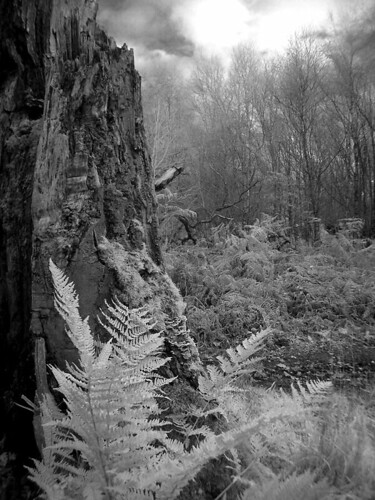
photo: Calderwood tree stump by Auchinoon


Some years ago I used to work as a personal trainer, and at the same time competed in full contact martial arts tournaments. Both of these activities required a level of fitness, especially the latter.

But however fit I wanted to be I knew that I couldn't train 24 hours a day, even if I was not training very hard.

To maximize the effects of my training I took another approach. I trained very intensely, then rested intensely.

What I told my clients with respect to exercise was this. You do not get stronger when you train, you get more tired and you get weaker. You get stronger when you rest, which is when the body adapts to the demands placed on it during training.

It applies when recovering between sets of an exercise during a session, as well as the periods between sessions. There are longer cycles of rest and recovery as well.

The same is true of non physical activities. Work too hard, do not rest and it results in burn out, and loss of effectiveness.

Many hard working people would like to be more productive. They try and fit more and more into the day, and cut out periods of rest. For many of the people I coach they benefit from keeping the rest periods, but improving the quality of relaxation.

Quality of relaxation is a skill. That is why so many people turn to Yoga and Taiji these days - to learn some of that quality. Breathing exercises and meditation are other ways to develop it.

Sometimes I catch myself half resting, half working, and not getting much done. I am making it a discipline to really go for my rest now, not even bother with a tea, but sit and relax. Sit and let go of everything. Maybe fall asleep for a few moments.

It is not always socially acceptable to do nothing, especially at work, but focused nothing is the purest form of rest, and can lead to the swiftest recovery. It may take some time to learn to relax deeply and quickly, but once developed it is a great ability.

There is a lovely Zen story that touches on this.

A master is lecturing the meditating monks 'If there is anything in your mind then throw it out.'

One young monk asks 'But what if my mind is already empty?'

'Then carry it out!'
the master replies

Daoist traditions use the image of being motionless, silent and inert like an old tree stump. Somehow that is an image that works for me, you can find what works for you.

So stop now for a moment, still yourself, and how still are you now? What else can you let go of knowing that it will be there when you come back?